How Luke Wiley Balances Art, Fatherhood & Authenticity – Secrets of Creative Growth
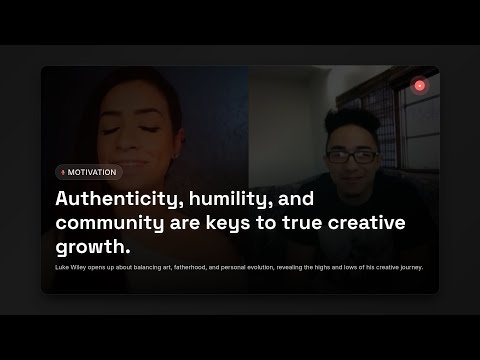
"I could have let the fact that my daddy was never there act like concrete on my feet in the ocean" — Luke Wiley, on choosing to build rather than sink.
How Luke Wiley Balances Art, Fatherhood & Authenticity — Secrets of Creative Growth
The latest episode of the Monica Black Diamond show, streaming on the Hustle Zone TV network, brings on rapper and self-described “BFF” of the host, Luke Wiley — a 22-year-old artist originally from Denver, Colorado, now based in Rapid City, South Dakota. Before anything else, Luke makes one thing clear about himself: “first and foremost before the music and everything, I am a father.”
The conversation opens with the show’s signature icebreaker — if you were a diamond or a rock, what would you be? Luke answers without hesitation: clear. “I think a clear diamond, because of the fact that I guess you can see every color in there,” he says, tying it directly to how he tries to live — as transparently as possible, with no secrets, in his relationships and in his music.
That transparency becomes the throughline of the episode once Luke walks through his origin story. He grew up without a stable father figure — a rotation of stepdads, and a biological father who was abusive toward his mother. His parents split when he was about a year old, and his father reappeared exactly once, when Luke was eight, only to announce he was moving away for good and that Luke would never see him again. In that single visit, his father gave him two CDs — 50 Cent’s Get Rich or Die Tryin’ and The Eminem Show — which Luke credits as the actual spark that got him into hip-hop. In an odd twist he shares on air, his own surname doesn’t come from his biological father at all: his mother had remarried a man with the last name Wiley, and even after that marriage ended in divorce, Luke kept the name — making him, as he puts it, the only person in his entire family who carries it. It became the foundation of his artist brand, the “Wiley movement.”
Luke also touches on being largely on his own by 14 and becoming a father himself at 17, alongside an early love of dance before he shifted fully into music. From there he’s built stage time by opening for names like Afroman, Twista, Paul Wall, and several artists connected to the Strange Music camp, largely by cultivating relationships with mentors and collaborators rather than chasing opportunities cold. He mentions recently moving on from a promotion company and currently being “under new management,” a transition he and the host both frame as a positive step.
Asked about his favorite performance, Luke picks a show with Afroman in Grand Junction, Colorado, where he crowd-surfed in front of hundreds of people — losing his glasses mid-air and being genuinely scared in the moment. But he gives real weight to Rapid City too, calling out the “hometown connection” the crowd there gives him even though he’s originally from Denver. That night, in fact, he was headed straight from the interview to a show he calls a “reunion,” co-headlining with a friend who’d returned to town after years away, alongside acts from Sioux Falls and a local Rapid City artist. As with every show under the Wiley movement banner, it doubled as a benefit event — $10 at the door, or $5 with a canned-good donation, with proceeds going to a mission.
When the host asks what advice he’d give an aspiring artist, Luke doesn’t sugarcoat it: “it’s hard,” full stop, and anyone serious about it should be ready for the roller-coaster nature of the work. His bigger warning is about ego — staying humble no matter how many cities love you, not becoming what he calls a “diva,” and never forgetting where you started, even if that start was performing for one person who happened to be your mom. He’s equally direct about crediting the people around him: his videographer Jeremy Snider of Riley House Productions, his friend C Green, his DJ, mentors Paul and Mike, his roommates Autumn and Maddie, and a friend named Shane who was driving him to the show that same night. What he says he’s learned most across his career is to actually stop and tell those people, out loud, that they’re seen and appreciated.
Before signing off, Luke plugs his newly released video “Angels and Demons,” shot in a cathedral as an intentional homage to Yelawolf’s “Best Friend” video and to Eminem’s influence on his sound, along with his album The Edge, available on iTunes and Spotify. He closes the episode with an unaccompanied verse — a raw piece about his father’s absence, the discipline it takes to build “the plate” rather than just show the finished meal, and his own vow never to repeat the cycle of harm with his child. It’s a fitting final note for an episode built entirely around one idea: staying transparent, even when the story is painful, is the whole point.
Lessons from this one
Deliberate transparency in creative work builds connection without needing to be engineered for relatability.
Research on content creators/performers who disclose personal, difficult material (rather than curated, calculated content) finds it shapes how audiences perceive and connect with them — supporting the idea that staying transparent about one's real story, rather than calculating for relatability, is what produces audience connection. This specific study looks at streamers disclosing mental health struggles, a close parallel to a musician disclosing personal history in lyrics, though it studies live-streaming audiences rather than concert/lyric audiences specifically.
Naming an intention to break a cycle of family harm can become a driving purpose for a parent.
The classic empirical study on intergenerational transmission of child abuse directly examined the widely-held assumption that abused children become abusive parents and found that only a minority (roughly one-third, not a majority) actually repeat the pattern — evidence that the cycle is not deterministic and that conscious intent/effort to not repeat it is a real, achievable, and researched phenomenon, contextualizing (rather than proving) Luke's specific closing-verse claim about his own resolve.
Guarding against ego is presented as an ongoing discipline for touring artists, not a one-time decision.
Recent personality-psychology research on narcissism and fame appeal finds distinct narcissism dimensions (grandiose vs. vulnerable) predict different fame-seeking motivations such as visibility and status appeal — supporting the general premise that fame/attention and ego-related traits are linked and worth actively monitoring in performers, though the study measures trait correlations in the general population rather than testing an ongoing 'discipline' intervention in touring musicians specifically.
A sustainable creative career runs on a named, visible support network rather than solo effort.
The foundational, widely-replicated 'buffering hypothesis' literature on stress and social support establishes that having a recognized network of supportive people measurably buffers individuals against stress and burnout — a general psychological finding consistent with (though not specific to) Luke's claim that naming and thanking his videographer, DJ, mentors, roommates, and driver is essential to sustaining his career, rather than that being studied directly in touring musicians.
Independent artists can fold community giving directly into their business model rather than treating it as separate charity.
A genuine search (web search and direct fetch attempts against academic databases, business-journal DOI resolvers, and Google Scholar) did not turn up a verifiable peer-reviewed study specifically examining artists structuring every show as a benefit/discounted-door-for-donation model as part of independent music business economics. General cause-related-marketing literature exists in the marketing field, but no specific source could be located and confirmed as actually existing this session, so none is cited. No controlled study found for this specific claim — reflects the guest's own described business practice, presented as such rather than as research-backed fact.
No controlled study found for this specific claim — reflects the guest's own lived/business experience, presented as such rather than as research-backed fact.
Sources
- Lee, Y.H., Yuan, C.W., & Wohn, D.Y. (2021). "How Video Streamers' Mental Health Disclosures Affect Viewers' Risk Perceptions." Health Communication (PMID: 32842773).
- Kaufman, J., & Zigler, E. (1987). "Do abused children become abusive parents?" American Journal of Orthopsychiatry, 57(2), 186-192 (PMID: 3296775).
- Greenwood, D., Archer, Q., Ash, S., & Keenan, J. (2025). "Connecting the dots between narcissism and fame appeal." Current Issues in Personality Psychology, 13(3), 202-210 (PMID: 40949592, DOI: 10.5114/cipp/197263).
- Cohen, S., & Wills, T.A. (1985). "Stress, social support, and the buffering hypothesis." Psychological Bulletin, 98(2), 310-357 (PMID: 3901065).
- Runtime
- 32m
- Show
- Monica Black Diamond
- Host
- Ryan Perez
Been through something like this?
Monica Black Diamond is conversations with people who built something out of the thing that was supposed to stop them. If that is you, say so.