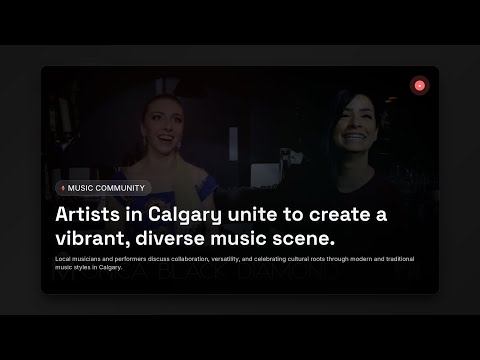
Calgary’s Diverse Artists Unite: How Community Spirit Is Transforming Local Music
As one Calgary trap artist put it during the interview, once you're truly dedicated and passionate, "whatever you're doing is going to speak for itself."
Calgary’s Diverse Artists Unite: How Community Spirit Is Transforming Local Music
This episode of the Monica Black Diamond show finds host Monica on location at a venue called Junction, working the room during a live event produced by Josh and supported by the Hustle Zone TV network. Across a series of quick, energetic sit-downs, Monica talks to a lineup of Calgary-based performers — a drummer-turned-hip-hop-artist, a classically trained dancer who moved into burlesque, a hip-hop/trap duo about to debut a brand-new single, and a pair of artists spanning hip-hop, soca, dancehall, and Latin pop. The common thread running through every conversation is one word Monica repeats throughout: unity.
From drums to hip-hop, with everything in between
The first guest, Monte Martino — known on stage as Mojo — traces his musical roots to drumming, which is what first pulled him into hip-hop. His sound now stretches across punk, hip-hop, and classical influences, though he’s clear that hip-hop remains the core of what he does. Performing live, Mojo says his goal is to “bring the culture back to hip-hop,” blending the vibe of a true MC with more modern, mainstream trap sounds so that, in his words, there’s “still some real hip-hop out there.” He’s most reachable through his Facebook page and Soundcloud under Mojo Martino, and on Instagram — he doesn’t currently have music on Spotify.
What stands out most in his segment isn’t just the music, but his read on the local scene itself: he tells Monica that Calgary doesn’t have enough people working together, and that what excites him about this particular show is seeing genres, acrobats, and dance choreography sharing one bill instead of staying siloed.
A dancer who found her way to burlesque
Next up is Audrey, whose performing background starts in classical dance — jazz, tap, ballet, and lyrical — and includes seven years of Irish dance as a kid before she pivoted toward storytelling-driven movement. She spent eight or nine years dancing with a local studio, and once she moved out on her own, she leaned into every class she could find, eventually producing her own burlesque shows that fold in acrobatics, aerial hoop, and pole work. She’s hoping to add silks to her repertoire this summer.
Audrey also teaches, and her burlesque troupe can be found on Instagram, with a companion website, alongside her personal performer page under the name Audrey Alice — a workaround, she explains, after Facebook wouldn’t let her register with her stage surname. Monica singles her out as an artist she’d been especially eager to see live, noting how rare it is to get this close to a burlesque performance in Calgary.
A trap duo debuting a single, live
A hip-hop and trap-focused duo tells Monica they’ve been building in Calgary for the past several years, developing a following primarily on Instagram and Soundcloud. Tonight’s Junction set is notable because they’re premiering a brand-new single that hasn’t been played for anyone before. Their advice to other artists coming up: stay dedicated, keep it real, and stay passionate — because, as they put it, “whatever you’re doing is going to speak for itself.” Being original, they add, is what eventually lets other people follow your lead rather than the other way around.
Genre-blending, homegrown, and welcoming collaborators
The final segment features two more artists — one working in Latin pop, the other refusing to lock into any single genre, pulling from hip-hop, soca, and dancehall. Both emphasize that everything they produce is homegrown, right down to using a Canadian producer and a Canadian mixing engineer. Their bigger point is about visibility: they want people to know that real talent exists locally in Calgary, not only in the United States or other countries, and they invite dancers, videographers, and other creatives to join their team if they’ve got the drive to contribute.
The throughline
What ties the whole episode together isn’t a single genre or style — it’s the insistence, repeated by nearly every guest, that Calgary’s scene grows when artists stop working in isolation and start showing up for one another, on the same stage, in the same city.
Watch the full conversation on the Monica Black Diamond show, presented by Hustle Zone TV.
Lessons from this one
Refusing to stay inside one genre broadens an artist's reach and relevance.
A large-scale study of nearly 27,000 Billboard Hot 100 songs found that music which sounds too typical of existing genre categories is less likely to succeed commercially, while differentiated, boundary-crossing work performs better — directly supporting the idea that resisting a single genre lane helps an artist's reach. A related study of feature films found genre-spanning works do draw larger overall audiences, though each individual viewer may rate them slightly less favorably than a single-genre work, a useful caveat rather than a contradiction.
Sustained, multi-year commitment to a craft precedes any visible 'break.'
The foundational deliberate-practice research on expert performers found that reaching an expert level in music and other skilled domains consistently requires roughly a decade or more of sustained, effortful practice, not raw talent alone or a short run-up — matching the pattern of Audrey's ~15-16 years of dance/burlesque training before headlining her own shows.
Artists repeatedly frame authenticity and originality as the real differentiator, more than technical polish.
A consumer-behavior study of artists as 'human brands' found that perceived authenticity (driven by artists' visible passion and commitment) shapes audience attitude toward the artist, which in turn drives evaluation of the work and behavioral intentions like purchase or support — consistent with guests' claim that 'keeping it real' matters more than surface polish. Note this study's stimuli were visual/fine artists rather than musicians specifically, so it should be read as adjacent literature on artist authenticity generally, not music-specific proof.
Local, homegrown production credentials are used by emerging artists as a point of pride and identity.
No controlled study found for this specific claim — reflects the guests' own lived experience and self-presentation strategy, presented as such rather than as research-backed fact. The closest adjacent scholarship is the sociological literature on music 'scenes,' which documents how local scenes generate their own markers of legitimacy and identity distinct from (and often in explicit contrast to) larger national/international music centers -- consistent with, but not direct proof of, the specific 'Canadian producer/mixer' framing described here.
Bennett, A., & Peterson, R. A. (Eds.). (2004). Music Scenes: Local, Translocal, and Virtual. Vanderbilt University Press.
Grassroots media platforms and local showcases fill a visibility gap that emerging artists say they can't get elsewhere.
Recent platform-studies research on Spotify's geography shows that artists outside major music-industry hubs face structural 'spatial gatekeeping' — regional/local intermediaries end up doing the visibility work that the platform's own algorithmic and editorial systems don't provide for peripheral scenes, which parallels guests' description of Hustle Zone TV filling a gap mainstream/national channels leave for Calgary artists.
Sources
- Askin, N., & Mauskapf, M. (2017). "What Makes Popular Culture Popular? Product Features and Optimal Differentiation in Music." American Sociological Review, 82(5).
- Ericsson, K. A., Krampe, R. T., & Tesch-Römer, C. (1993). "The Role of Deliberate Practice in the Acquisition of Expert Performance." Psychological Review, 100(3), 363-406.
- Moulard, J. G., Rice, D. H., Garrity, C. P., & Mangus, S. M. (2014). "Artist Authenticity: How Artists' Passion and Commitment Shape Consumers' Perceptions and Behavioral Intentions across Genders." Psychology & Marketing, 31(8).
- Bennett, A., & Peterson, R. A. (Eds.). (2004). Music Scenes: Local, Translocal, and Virtual. Vanderbilt University Press.
- Hroch, M., & Szczepanik, P. (2025). "Playlisting the Periphery: Platform Intermediaries and East-Central European Music Visibility in Spotify's Geography." New Media & Society, 28(7), 3416-3435.
- Runtime
- 22m
- Show
- Monica Black Diamond
- Host
- Ryan Perez
Been through something like this?
Monica Black Diamond is conversations with people who built something out of the thing that was supposed to stop them. If that is you, say so.