Will Haze on Hip Hop, Authenticity & Calgary's Rise – Inspiration for Creatives
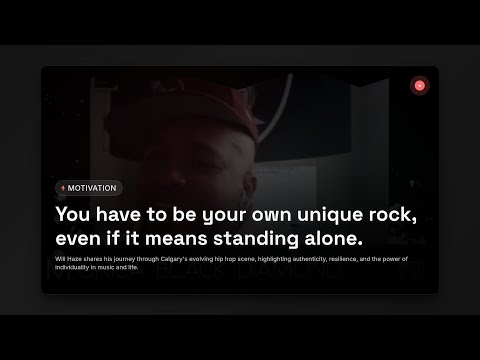
Will Hayes's real challenge to every artist: "What are you doing different from the man to your left and the man to your right?" — because everyone else already has what you have.
Will Hayes on Hip Hop, Authenticity & Calgary’s Rise — Inspiration for Creatives
Before he was Will Hayes, he was Kane Cash — “Kane Cashes Kane” to anyone who knew him before 2000. On this episode of the show, Monica sits down with the Calgary entertainer, podcast host, and hip hop artist to talk about what it actually takes to build a scene from nothing, why authenticity is the only currency that lasts, and why he’s stepped back from rapping even as his platform keeps growing.
Will opens by describing himself less as a rapper and more as “an entertainer for higher” — someone who makes music and does production, but has increasingly shifted toward being a personality who “brings the culture to people” rather than just being a product in it. That shift shows up in his slate of projects: the Will Hayes Show, hosting gigs, and a new podcast in the works. He traces the instinct back to childhood, joking that his mother used to say he could “sell fire to the devil,” and that people called him “motor mouth” because his mouth never stopped.
When Monica poses her signature question — if you were a diamond or a rock, what would you look like? — Will leans all the way into the bit, describing himself as an oblong, athletic rock that can skip across water eight times, one that would apologize if it accidentally hit you in the back of the neck. It’s a funny, self-aware answer, and it sets the tone for a conversation that stays candid even as it gets serious.
The heart of the episode is Calgary itself. Will is blunt about how hard it was to build a hip hop scene in a city he calls “the anti-hip-hop city” — describing clubs run by people who used dress codes to keep out the urban community and wouldn’t play urban music, while rougher venues came with real danger. He and others who came up before him didn’t have anywhere to host hip hop shows, so they built their own venues from scratch, laying a foundation he says later artists — and the current club scene — are now standing on.
He draws a sharp contrast between Calgary and hip hop scenes in the United States. In the U.S., he says, local communities tend to push their own rappers up even when there’s competition for the same spotlight. In Calgary, he argues, the opposite happens — the city tends to tear down the one person who’s trying to make it. On the flip side, he offers real praise for Calgary’s female rappers, naming Nicki Louise and Brandon City as standouts, and mentioning that he taught Nicki Louise to rap back in the ’90s, before she “surpassed” him.
Authenticity is the through-line of the whole conversation. Will argues that most of today’s music is technically solid but interchangeable — trap beats, in particular, tend to blur together — and that the artists who actually last are the ones who sound like no one else. He points to Cash Money, Wu-Tang, Bone Thugs-n-Harmony, and Future as acts that set trends rather than chased them, and uses Post Malone’s early “White Iverson” era as an example of an artist who was distinct before the copycats arrived. He also contrasts Eminem’s bar-heavy controversy with what he sees as hollow imitators. His challenge to any artist, and really to anyone: “what are you doing that’s setting you apart” from the person sitting next to you?
That question is also why he’s pulled back from rapping himself. He admits candidly that his mouth, his opinions, and his show now pull more attention than his music ever has — a fact that frustrates him even as he leans into it. The Will Hayes Show airs weekly, and he’s become selective about who gets booked, judging potential guests by how their content performs before offering them a slot.
Toward the end, Will turns reflective about hip hop’s staying power, describing the culture as something that pushes out whatever doesn’t belong the way a body eventually pushes out a bullet — battered sometimes, but never destroyed. His closing advice to artists still finding their footing is simple and direct: don’t stop, give it everything, and don’t let anyone else’s opinion decide your worth unless it’s adding something positive. If people aren’t fans yet, he says, make them fans.
Monica closes out the episode with a shoutout to the network for creating space for conversations like this one — real, unfiltered, and rooted in the actual work of building something in a city that didn’t make it easy.
Lessons from this one
In a saturated creative market, sounding different is the only real competitive advantage.
Will Hayes argues that most current music is technically fine but interchangeable, especially within trap, and that only artists who set their own trend (Cash Money, Wu-Tang, Future, early Post Malone) end up lasting. His direct challenge — what are you doing differently from the person next to you — frames distinctiveness as the actual product being sold.
Sharp, B. (2010). How Brands Grow: What Marketers Don't Know. Oxford University Press.
A local scene's growth depends on whether its community lifts up or tears down its own emerging talent.
Will contrasts U.S. hip hop scenes, where he says communities push their own rappers upward even amid competition, with Calgary, where he says the city tends to tear down the one person trying to break out.
Structural gatekeeping (like discriminatory dress codes) can stunt a genre's local growth for years.
Will describes Calgary clubs using dress-code policies to exclude the urban community and refusing to play urban music, forcing early hip hop artists to build their own makeshift venues just to have somewhere to perform.
No controlled study or documented case specific to Calgary club dress-code enforcement against hip hop/urban culture was found after a genuine search (general reporting on discriminatory dress-code enforcement at bars/nightclubs elsewhere exists, but nothing specific and verifiable enough to cite responsibly turned up). This point reflects the guest's own lived account of Calgary's scene, presented as his testimony rather than as research-backed fact.
Personal brand and personality-driven content can outgrow the original creative product that built the audience.
Will admits his mouth, opinions, and show now draw more attention and viewers than his music ever has, despite music being his original craft — a shift he says pushed him to go all-in on hosting rather than rapping.
Creative persistence requires filtering out outside opinion and defining success on your own terms.
Will's closing advice to artists is to never stop, give it full effort, and not let anyone else's opinion of you matter unless it adds positivity — essentially building your own definition of momentum rather than waiting for validation.
Sources
- Sharp, B. (2010). How Brands Grow: What Marketers Don't Know. Oxford University Press.
- Feather, N. T. (1989). Attitudes towards the high achiever: The fall of the tall poppy. Australian Journal of Psychology, 41(3).
- Senft, T. M. (2008). Camgirls: Celebrity and Community in the Age of Social Networks. Peter Lang.
- Duckworth, A. L., Peterson, C., Matthews, M. D., & Kelly, D. R. (2007). Grit: Perseverance and Passion for Long-Term Goals. Journal of Personality and Social Psychology, 92(6), 1087-1101.
- Runtime
- 33m
- Show
- Monica Black Diamond
- Host
- Ryan Perez
Been through something like this?
Monica Black Diamond is conversations with people who built something out of the thing that was supposed to stop them. If that is you, say so.