DJ Vex Kobo’s Inspiring Music Journey – Passion, Collaboration & Community
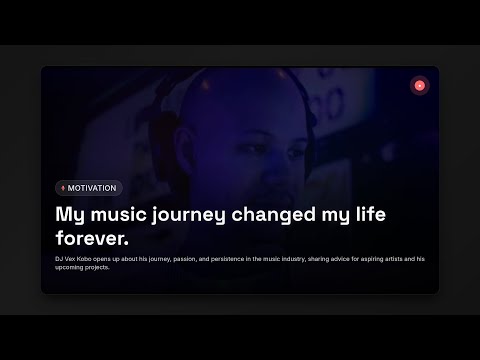
"Knowledge is free, wisdom is free — it doesn't make sense me going to my grave and not teaching people what I know."
DJ Vex Kobo’s Inspiring Music Journey – Passion, Collaboration & Community
Some music careers start with a plan. John — known to Calgary audiences as Vex Kobo, or simply Vex — didn’t have one. In this episode of Monica Black Diamond’s show, hosted alongside a shoutout to Ryan Perez and the Hustle Zone TV Network, Vex sat down (after admitting the crew was running “so late” thanks to a wild weather day) to talk through nearly two decades behind the turntables and the mic.
Vex’s story actually begins in Trinidad, at age 11, walking into a new school and entering a talent competition mostly because, in his words, he was “the new kid” and figured he’d see what he could do. He wrote a Calypso song for the occasion and placed third out of roughly 30 performers — a result that, as he pointed out, carried real weight in a school that size, and it earned him a little early notoriety. That early spark wasn’t quite a lightning-bolt moment of destiny, though. Vex was candid that he can’t claim he “knew it in his soul” the way some artists describe it. Instead, he credits growing up in a musical Caribbean household — both parents played instruments and sang in choir — for making performing feel like a natural extension of who he already was.
The DJ side of his career came together even less deliberately. A friend was throwing an after-grad party where the crowd had specifically requested reggae and hip hop. The friend, a budding DJ himself, didn’t know reggae — but Vex did. He hadn’t touched a turntable before that night, got thrown in anyway, and had a blast. From there, as he put it, “everything kind of fell into place.” DJing didn’t just become a passion project; it paid his way through school, funding his tuition while he studied.
Two decades later, Vex is juggling a day job as a structural steel designer with a full creative life: writing, recording, and producing his own material — instrumentals, lyrics, and vocals — entirely himself. He’s got an album in the works, tentatively titled “Vex Toy,” and while he’s stepped back from the festival circuit (he used to be a regular at Car Fest) and is keeping social media quiet for now, it’s by design — he wants the music and the online presence buttoned up before he pushes any promotion.
A recurring theme of the conversation was community. Vex talked about currently working with a handful of Calgary artists he’s genuinely impressed by, including a monthly hip hop show featuring a group of young, talented rappers, and a collaborator named Adrian. He was candid about the practical challenge of doing that work from Calgary rather than a hub like New York or LA — it’s harder to market Caribbean- or Latino-influenced sounds from here — but he’s optimistic that the internet is leveling that playing field. He also spoke warmly about being embraced by Calgary’s Latino community, joking that Trinidad’s geographic closeness to Venezuela makes him “somewhat Latino” by association.
When asked what advice he’d give to artists coming up, Vex kept it simple and grounded: be persistent, and actually learn your craft. He was blunt that passion alone isn’t enough — “passion only takes you so far… you have to work hard for it,” and he noted that even people who do put in the work don’t always make it. His third piece of advice was about intention: don’t chase fame, stay humble, and do it for the art itself. He also emphasized generosity with what he’s learned, saying flatly that it “doesn’t make sense” to hold onto knowledge instead of passing it on to others coming up behind him.
Throughout the conversation — which also included some good-natured ribbing about Vex’s single status and a fun aside about what color diamond he’d be (red, for passion) — what came through most was a working artist’s perspective: unglamorous origin stories, a day job alongside the music, and a genuine investment in the artists around him. Vex can currently be reached through Facebook under the name John Vex, where he says he’ll share more once the album and its rollout are ready.
Lessons from this one
Passion is the fuel, but craft and hard work are what actually get you there.
Vex was direct about this, saying passion only takes you so far and that you have to work hard for it — and he noted that even people who work hard at music don't always make it anywhere.
Some of the biggest career turns come from unplanned, thrown-into-it moments rather than a deliberate plan.
Vex got into DJing by accident, filling in for a friend's after-grad party that needed reggae despite never having touched a turntable before — and that improvised gig ended up funding his tuition through school.
Mentoring and openly sharing hard-won knowledge helps sustain a local creative scene.
Vex talked about working directly with up-and-coming Calgary artists and rappers and said it 'doesn't make sense' to withhold knowledge and wisdom he's accumulated instead of passing it on.
Geography can limit a niche artist's reach, but digital platforms help close that gap.
Vex described it as genuinely harder to market Caribbean- and Latino-influenced music out of Calgary compared to hubs like New York or LA, but pointed to the internet as the equalizer for reaching an audience regardless of location.
Shared cultural affinity, not exact ethnic overlap, can build genuine cross-community belonging.
Vex, who is Trinidadian, described being embraced by Calgary's Latino community and jokingly attributed it to Trinidad's geographic proximity to Venezuela, pointing to a felt kinship beyond strict categorization.
Sources
- Duckworth, A. L., Kirby, T. A., Tsukayama, E., Berstein, H., & Ericsson, K. A. (2011). Deliberate Practice Spells Success: Why Grittier Competitors Triumph at the National Spelling Bee. Social Psychological and Personality Science, 2(2), 174-181.
- Krumboltz, J. D. (2009). The Happenstance Learning Theory. Journal of Career Assessment, 17(2), 135-154.
- Wang, J., & Shibayama, S. (2022). Mentorship and creativity: Effects of mentor creativity and mentoring style. Research Policy, 51(3), 104451.
- Verboord, M., & van Noord, S. (2016). The online place of popular music: Exploring the impact of geography and social media on pop artists' mainstream media attention. Popular Communication, 14(2), 59-72.
- Lidskog, R. (2016). The role of music in ethnic identity formation in diaspora: a research review. International Social Science Journal, 66(219-220), 23-38.
- Runtime
- 22m
- Show
- Monica Black Diamond
- Host
- Ryan Perez
Been through something like this?
Monica Black Diamond is conversations with people who built something out of the thing that was supposed to stop them. If that is you, say so.