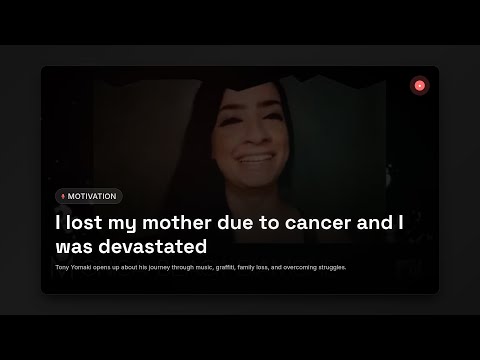
How Tony Yomaki Overcame Loss & Turned Struggles Into Motivation Through Music
Adequate's core advice to artists grinding it out: use other people's negativity as your positivity, and treat every setback like Edison treated a failed light bulb — not a failure, just one more way that didn't work.
“# How Tony Yomaki Overcame Loss & Turned Struggles Into Motivation Through Music\n\nOn this episode of the Monica Black Diamond show, host Monica welcomed rapper Tony Yomaki — known on stage as Adequate — for a conversation about grief, grind, and building a hip-hop career out of British Columbia. Tony explained the story behind his stage name early on: "adequate" means satisfactory or up to par, a deliberately humble label rather than an egotistical one, paired with a personal slogan — "but more than" — because he’s adequate, but more than that too.\n\nBorn in Campbell River and raised across British Columbia, including stretches in Kamloops and Kelowna, Tony traced his musical roots back to childhood, listening to his dad’s mix of Eminem, Linkin Park, and Limp Bizkit starting around age four or five. From there he found Nas, Tupac, Big L, and Obie Trice, artists he says fueled his love of rap. The real turning point came in a grade six or seven drama class, when he convinced his teacher to let him write raps instead of poetry for an assignment — and never really stopped.\n\nGraffiti entered the picture around the same time; Tony said he’s been doing it since he was twelve, and has been arrested for it more than once. But the deeper catalyst was personal loss: his father passed away when Tony was thirteen, in 2009, leaving him with what he described as pent-up rage and emotion. Rapping and graffiti became the outlet for that anger, and the same graffiti crew he and his friends started around 2009-2010 eventually grew into the clothing company behind a Kickstarter campaign he had just launched at the time of this interview.\n\nAsked about the hustle behind the music, Tony described loving the solitary, focused grind of sitting down and getting work done, calling the money and time he invests now "paying dues" rather than money lost — framing it as an investment in a future payoff rather than a sacrifice. He also spoke about wanting to represent an underrepresented side of BC culture, pushing back on outside perceptions of the province as just "hippies and loggers," and tracing his own family story — a mother working two jobs as a single parent raising him and his brother — into his lyrics and word play.\n\nA recurring theme was collaboration beyond his own backyard. Tony pointed to work he was doing with an artist in Queensbridge, New York, and another based in Alberta, arguing that too many artists limit themselves early on by only working with people in their immediate area. Expanding outward from the start, he said, builds real connections rather than just a bigger network. When asked who he’d most want to work with, he named Apathy of Demigodz — a Connecticut-based artist he admires for handling beats, raps, and intelligent subject matter all at once.\n\nAt the time of the interview, Tony had an EP or album in the works with no fixed length decided yet, plus a run of shows lined up with Junan Locksmith across Prince George, Vancouver, and Vernon in mid-June, and a cross-Canada tour he was helping bring Robbie G through. He gave a shout-out to D Dai Entertainment for connecting him to the Monica Black Diamond show and for bringing him up to open for Mercules in Terrace the year before, along with the promotions team and fellow artists helping him sell tickets for upcoming shows.\n\nThe conversation closed on advice for other artists grinding through the same process. Tony’s central piece of encouragement was to use other people’s negativity as fuel rather than letting it discourage you — invoking Thomas Edison’s famous reframe of his many failed light bulb attempts not as failures, but as hundreds of ways that didn’t work on the way to the one that did. He also shared a written note he keeps on his desk as a personal reminder: if you only do things when you feel like doing them, they never get done. Though he hasn’t formally battled in a league yet, Tony said he watches battle rap regularly and hopes to get into it eventually. The episode closed with a clip of one of his songs, touching on anxiety and depression alongside the hustle themes discussed throughout the interview.\n”
Lessons from this one
Channeling grief and anger into a creative outlet can turn personal loss into long-term motivation.
Tony said his father's death when he was thirteen left him with pent-up rage and emotion, which pushed him into graffiti and rapping as an outlet that eventually became his career.
Reframing upfront costs as 'paying dues' rather than losses makes early sacrifice easier to sustain.
Tony described spending money now with no immediate return as an investment in his future rather than money lost, explicitly contrasting this framing with how he sees other people in early careers talk about it.
Seeking collaborators outside your local scene early on builds stronger, farther-reaching creative networks.
Tony said many artists limit themselves by only working with people in their own area early in their career, while he intentionally collaborated with artists in Queensbridge, New York and Alberta from early on.
Deliberately reframing criticism as motivation protects creative confidence and productivity.
Tony described taking negative feedback about his clothing line and turning it into positive fuel, and cited the story of Edison treating failed light bulb attempts as discovered non-solutions rather than failures.
A simple written reminder can counter the unreliability of relying on motivation alone to get work done.
Tony keeps a note on his desk stating that if you only do things when you want to do them, they never get done, using it as a self-discipline check.
Sources
- Tedeschi, R.G., & Calhoun, L.G. (1996). "The Posttraumatic Growth Inventory: Measuring the Positive Legacy of Trauma." Journal of Traumatic Stress, 9(3), 455-471.
- Stuckey, H.L., & Nobel, J. (2010). "The Connection Between Art, Healing, and Public Health: A Review of Current Literature." American Journal of Public Health, 100(2), 254-263.
- Mischel, W., Shoda, Y., & Rodriguez, M.L. (1989). "Delay of Gratification in Children." Science, 244(4907), 933-938.
- Granovetter, M.S. (1973). "The Strength of Weak Ties." American Journal of Sociology, 78(6), 1360-1380.
- Gross, J.J., & John, O.P. (2003). "Individual Differences in Two Emotion Regulation Processes: Implications for Affect, Relationships, and Well-Being." Journal of Personality and Social Psychology, 85(2), 348-362.
- Gardner, B., Lally, P., & Wardle, J. (2012). "Making Health Habitual: The Psychology of 'Habit-Formation' and General Practice." British Journal of General Practice, 62(605), 664-666.
- Runtime
- 27m
- Show
- Monica Black Diamond
- Host
- Ryan Perez
Been through something like this?
Monica Black Diamond is conversations with people who built something out of the thing that was supposed to stop them. If that is you, say so.