From Job Loss to Sales Success
Scott Braun’s Powerful Motivation & Career Advice
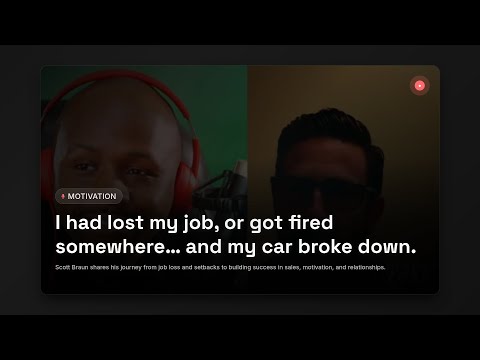
Scott Braun's whole sales philosophy comes down to one line: get out of the customer's way and let them buy the car, instead of talking them out of it.
From Job Loss to Sales Success: Scott Braun’s Powerful Motivation & Career Advice
Some careers start with a plan. Scott Braun’s started with a broken-down car and an empty wallet.
On this episode of Hustle Zone, host Ryan Perez sat down with Scott Braun, a floor manager and top salesperson at Dave Sinclair Ford in St. Louis, who sold over 200 vehicles in 2016. Braun, who Ryan introduces as a longtime supporter of the show and a “true Hustler” with a famously calm, low-key demeanor, walked through how a rough patch turned into a career that’s “blessed” his family — and shared the habits that separate salespeople who last from the ones who burn out.
A demo car and a busy highway
Braun’s entry into car sales wasn’t strategic. He’d lost his job, and shortly after, his car broke down — and he didn’t have the money to fix it. He’d heard that dealerships give employees free demo cars, so he walked across a busy highway (I-270) to a dealership near his home outside St. Louis, applied on the spot, and took the aptitude test they gave applicants. A callback for a formal interview came soon after, and he was hired a couple of weeks later. “If it wasn’t for my car breaking down, I don’t know that I’d have done it,” he said. Nearly a decade later, he calls the ride “very good,” crediting the business with providing for his family.
Growing up in Washington, Missouri
Braun grew up in a small town about 40 to 45 minutes outside St. Louis, in the country, near a farm. His mother stayed home; his father did concrete and foundation work — physically demanding labor that Braun watched take a toll over the years, from back problems to visible aging. “I always told myself… there’s no way I want to ever be in that type of business,” he said. He’s one of six siblings — three brothers and two sisters.
That upbringing also shaped how he parents his own son, who was two at the time of the interview. Because his father was gone so much for work, Braun said he wants to be home more, and he’s intentional about letting his son find his own path without limits — even, he joked, if that path is being a janitor.
Learning to soften the pitch
Ryan shared his own car-sales memory of coming on too strong until a sales manager told him to “soften the voice.” Braun’s version of that lesson is central to how he sells: he treats customers like they’re sitting at a bar or at his kitchen table, talking about their family and their life rather than being pitched. “I don’t treat him like a walking dollar sign,” he said — a mindset he credits for customers telling him it was the best car-buying experience they’ve had.
Braun was candid about the early grind, too. His dealership paid a wage for the first two months; by the third month, he was on straight commission, and he said the first couple of years were a struggle. He pointed to finding a mentor — someone already selling a lot — as one of the moves that turned things around, along with learning to tune out the veteran “old dogs” who were territorial with newer salespeople.
The advice he’d give any new salesperson
Asked for his core sales philosophy, Braun kept coming back to a few ideas: get out of the customer’s way and let them buy, rather than talking so much you talk them out of it; don’t be “too nice” when it’s time to close; and figure out the real objection — as he put it, it’s almost always “me, the money, or the machine” — so you can address it directly instead of letting the customer walk. He also emphasized asking for commitment repeatedly and following up relentlessly: calling past customers, sending birthday cards, and building a referral base through his dealership’s “bird dog” program and his church community, rather than relying on walk-in traffic alone.
Life outside the lot
Away from the dealership, Braun described working 55 to 60 hours a week at a family-run dealership that closes Sundays and gives staff one weekend off a month. He named “Wall Street” as his favorite movie — he’s drawn to Gordon Gekko’s competitive instinct — with “Boiler Room” a close second, and said he sees himself as a mix of Gekko at work and a low-key family man off the clock. His bucket-list trip is Bora Bora, and he’s looking forward to more camping and hiking with his son as he gets older.
Braun closed with a simple piece of advice for anyone considering the business: treat people like human beings, and find a dealership with a good reputation — because how a company treats its employees is how those employees end up treating customers.
Lessons from this one
A single unplanned setback can accidentally launch an entire career.
Scott Braun got into car sales only because he'd lost his job and then couldn't afford to fix his broken-down car, so he walked across a highway to a dealership for a free employee demo car. He says outright that without the car breaking down, he doesn't know he'd have ended up in the business at all.
New salespeople benefit enormously from finding a mentor early rather than figuring it out alone.
Braun said his first couple of years in car sales were a struggle, and that one of the key turning points was finding a mentor who was already selling a lot, watching how they interacted with customers, and adopting those habits.
Repeated small exposure to a feared situation is how salespeople overcome fear of approaching strangers.
Braun described having to get over the fear of walking up to a new customer every single day, forcing himself to put on a smile and repeat the same approach over and over until it became natural and he 'got it down.'
Long-term sales success is built on trust and relationships, not closing tricks.
Braun repeatedly emphasized treating customers like people rather than 'a walking dollar sign,' building his referral base through his dealership's bird-dog program and his church network, and noted that if customers don't trust or like a salesperson, they won't refer friends or family.
Commission-only pay structures drive very high early attrition among new salespeople.
Braun said his dealership pays a wage for the first two months before switching new hires to straight commission, and that the business has to hire around ten people to end up keeping one or two, since many can't handle going from a steady paycheck to zero guaranteed income.
Sources
- Krumboltz, J.D. (2009). "The Happenstance Learning Theory." Journal of Career Assessment, 17(2), 135–154.
- Allen, T.D., Eby, L.T., Poteet, M.L., Lentz, E., & Lima, L. (2004). "Career benefits associated with mentoring for protégés: A meta-analysis." Journal of Applied Psychology, 89(1), 127–136.
- Mayo-Wilson, E., Dias, S., Mavranezouli, I., Kew, K., Clark, D.M., Ades, A.E., & Pilling, S. (2014). "Psychological and pharmacological interventions for social anxiety disorder in adults: A systematic review and network meta-analysis." Lancet Psychiatry, 1(5), 368–376.
- Doney, P.M., & Cannon, J.P. (1997). "An Examination of the Nature of Trust in Buyer-Seller Relationships." Journal of Marketing, 61(2), 35–51.
- Tremblay, M., Côté, J., & Balkin, D.B. (2003). "Explaining Sales Pay Strategy Using Agency, Transaction Cost and Resource Dependence Theories." Journal of Management Studies, 40(6), 1651–1682.
- Runtime
- 52m
- Show
- HustleZone
- Host
- Ryan Perez
Been through something like this?
HustleZone is conversations with people who built something out of the thing that was supposed to stop them. If that is you, say so.