From Trauma to Triumph
Ashley Pettigrew's Journey of Healing & Empowerment
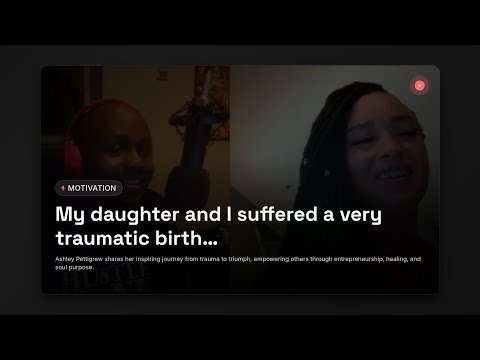
Ashley Pettigrew's guiding principle: "it's not entrepreneurship first, it's creating from your soul first, entrepreneurship second" — because chasing money and status just buys you pressure, not purpose.
From Trauma to Triumph: Ashley Pettigrew’s Journey of Healing & Empowerment
Some episodes of Hustle Zone stay light. This one didn’t stay light for long — and host Ryan Perez said as much going in, telling viewers to “brace yourself” because this was going to be “a really deep Hustle Zone.”
His guest was Ashley Pettigrew, a mobile yoga teacher, holistic healer, and psychic medium based in Calgary. Perez has known her since they were teenagers — they met at an all-ages club in 2000 through a mutual friend, lost touch, and reconnected years later on LinkedIn. What he found was someone who had rebuilt her entire life around what she calls “soul-driven entrepreneurship.”
A birth that nearly took two lives
Ashley’s turning point arrived in 2014. She was working a high-paying corporate job in the oil and gas industry — comfortable, stable, and unfulfilling — when she went into labor with her daughter, Amari. What followed was a medical emergency: her placenta tore away from her uterus, she required six blood transfusions, and she went into a C-section on the edge of death. Amari was born in crisis too, and doctors told Ashley her daughter would likely never open her eyes, never eat, never smile — that she “would just be a vegetable.”
None of that happened. Ashley described walking into the NICU after three days apart from her newborn, looking at her, saying her name, and watching Amari slowly open her eyes and turn toward her voice — a moment she said her mother has on video. Ashley had picked the name Amari five years before she ever had a daughter; she later learned it means “strength” and “promised by God.”
That experience, she said, forced her to “think differently” and to build something that could feed her soul while still being present for her daughter. Several business ideas failed before she found her footing in healing work roughly a year before this conversation.
Selling cigarettes, losing the house, and learning not to ask for help
Long before any of that, Ashley was already hustling. As a kid, she sold her father’s cigarettes to high schoolers just to fund trips to the candy store — an early, imperfect lesson in making her own money. Life got harder at ten, when her parents divorced, her father left, and her mother raised three daughters alone. The family lost their home and relied on social assistance and the food bank while her father struggled with a long addiction. Ashley said that period left her with a belief she carried for years: that she couldn’t rely on anyone and had to do everything herself.
She also described a quieter, stranger thread running through her childhood — hearing voices from her closet as a girl, finding comfort sleeping there, and never telling anyone. She now works as a psychic medium and healer, running two-month programs designed to surface and release the “false belief systems” she says hold people back.
Soul first, business second
The conversation’s clearest thesis came when Ashley pushed back on the textbook definition of entrepreneurship. Rather than chasing money, status, or fame, she argued for building “from your soul first, entrepreneurship second” — pointing to entrepreneurs she knows who are financially successful but personally miserable. Her own father, a restaurant franchise owner she called a natural “money magnet,” warned her directly that he’d been undone by pressure, and told her the industry isn’t for anyone who can’t handle it.
She also spoke candidly about a 2008 relapse into heavy drinking after ending an engagement, and about reuniting with her father as an adult — a trip Perez said mirrored his own journey meeting his father in Guyana. Both described that reunification as filling in a missing piece they hadn’t realized was driving so many of their choices.
Other threads touched on setting boundaries as a woman in business, skepticism toward “The Secret” and the Law of Attraction without addressing the deeper belief-system work required to actually change one’s life, and practical talk about eating clean, local food.
Asked what she’d tell her younger self, Ashley didn’t hesitate: “You’re worthy, you’re loved, and you’re going to be okay.”
The episode closed, as Hustle Zone often does, with a nod to Perez’s other project — Bow Tie Kreative’s initiative donating free websites to entrepreneurs with disabilities, inspired by Calgary business owner Michael Haynes.
Lessons from this one
Surviving a medical crisis can become the catalyst for redefining purpose rather than just a hardship to recover from.
Ashley described a traumatic 2014 birth in which she and her daughter Amari nearly died, and said that experience forced her to abandon her stable corporate job and rebuild her life and career around healing work.
Childhood financial and family instability can wire adults toward extreme self-reliance and distrust of help.
Ashley said losing her home and going on social assistance after her parents' divorce at age 10 left her with a lasting belief that she had to do everything alone and couldn't rely on or trust others.
Entrepreneurs who build a business around external validation (money, status, fame) may pay for it with personal misery, while purpose-aligned founders report less internal pressure.
Ashley described knowing very successful entrepreneurs who are miserable and unhealthy, and said her own father, who ran restaurant franchises, told her pressure was what undid him; she framed her own approach as needing to be soul-driven first to avoid that trap.
Believing you are personally deserving of a goal may be a precondition for actually achieving it, more than the goal-setting itself.
Ashley described a 2008 period of heavy drinking after leaving a relationship, and said she only turned her life around and hit her goals within a year once she confronted her own false belief systems and accepted that she deserved what she wanted.
Reconnecting with an absent parent can resolve a sense of identity gap that indirectly shaped years of prior decisions.
Both Ashley and Ryan described meeting an estranged father as adults as a turning point that filled in a 'missing component' they felt had been unconsciously driving earlier choices and business ventures.
No controlled study found for this specific claim. A genuine, real research area exists on family estrangement and reconciliation broadly — for example Kylie Agllias's Family Estrangement: A Matter of Perspective (Routledge, 2017) and Karl Pillemer's Fault Lines: Fractured Families and How to Mend Them (Avery, 2020), the first large-scale U.S. national survey of family estrangement — but that literature studies estrangement/reconciliation patterns and their emotional effects generally, not the specific mechanism Ashley and Ryan describe (an unconscious 'identity gap' from an absent parent shaping years of earlier business and life decisions until reunification resolves it). That specific causal claim reflects the guests' own lived interpretation of their experience, presented as such rather than as a research-backed finding.
Sources
- Tedeschi, R. G., & Calhoun, L. G. (1996). "The Posttraumatic Growth Inventory: Measuring the Positive Legacy of Trauma." Journal of Traumatic Stress, 9(3), 455–471.
- Felitti, V. J., Anda, R. F., Nordenberg, D., Williamson, D. F., Spitz, A. M., Edwards, V., et al. (1998). "Relationship of Childhood Abuse and Household Dysfunction to Many of the Leading Causes of Death in Adults: The Adverse Childhood Experiences (ACE) Study." American Journal of Preventive Medicine, 14(4), 245–258.
- Deci, E. L., & Ryan, R. M. (1985). Intrinsic Motivation and Self-Determination in Human Behavior. New York: Plenum.
- Bandura, A. (1977). "Self-Efficacy: Toward a Unifying Theory of Behavioral Change." Psychological Review, 84(2), 191–215.
- Runtime
- 1h 34m
- Show
- HustleZone
- Host
- Ryan Perez
Been through something like this?
HustleZone is conversations with people who built something out of the thing that was supposed to stop them. If that is you, say so.