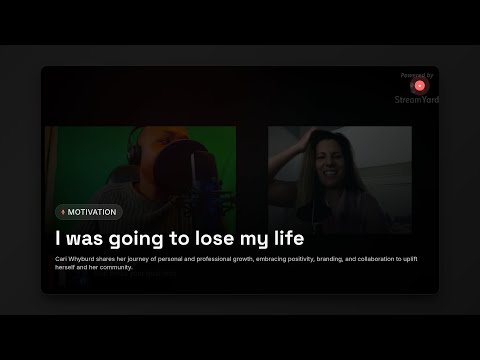
How Cari Whyburd Transformed Her Life with Positivity & Branding | Motivational Story
When your ideas keep getting shot down somewhere else, that's not rejection — it's the universe handing you the blueprint for your own thing.
How Cari Whyburd Built “Underground Radio C” Out of a Rough Patch
This episode of Go Live and Prosper — Ryan Perez’s long-running show under the Hustle Zone / Bow Tie Kreative banner — features Cari Whyburd, a Facebook connection of Ryan’s who he’d admired from a distance for her consistent positivity online. The conversation, recorded live (and interrupted more than once by audio glitches and a stray phone call), traces how a personal low point turned into her own radio brand, Underground Radio C.
From Cleaning Jobs to a Radio Booth
Cari’s story starts a few years back, in the middle of a separation, when she needed steady income. A friend who owned a cleaning company brought her on, and Cari worked that job for a while. When the work slowed down, she started scanning listings on Facebook Marketplace, Indeed, and other job sites — and came across a posting for a radio show host. She figured she had nothing to lose, sent in her resume, and heard back within two days.
The interview itself became a small saga: the station had moved without updating the address, and Cari ended up driving around the city in a blizzard trying to find a building that no longer existed. The host finally called her back and conducted the interview over the phone while she sat parked somewhere in the storm. It lasted about half an hour — and she got the job. She credits her personality and positivity for landing it, and within a week she was in the studio, still cleaning on the side to make ends meet.
She spent time learning the craft — booking interviews, working with visiting artists — and later learned from a parent that, as a child, she’d said she wanted to work in radio, a detail that surprised her when it came up.
When Ideas Get Shot Down
Cari brought a steady stream of creative pitches to the station owner — ideas for branding, going live on location, expanding what the show covered. Some were turned down, which she chalked up to it being someone else’s business to run as they saw fit. But friends started pointing out that the station wasn’t growing the way her ideas deserved to. Around eight months before she eventually left, she began quietly jotting down her own concepts: who she’d want to interview, what she could build if she ever went out on her own.
The Surprise Logo
Branding came next — a name, a color, a logo. She toyed with “Radio C” (a nod to her name and her love of pink, which she calls a core part of who she is), but discovered other radio brands already used variations of that name. Working with her business partner Natasha (of Evo King Management) and Daniel Sutherland, she landed on Underground Radio C — a name that let her keep the personal “C” while gesturing at something bigger. The logo itself hides city imagery inside the word “underground,” a reference to Calgary, which she describes as a city full of flourishing artists and entrepreneurs.
Before any of the business planning happened, though, came an emotional turning point: her best friend and longtime neighbor, Alexandra Serrado — an entrepreneur Cari had helped for years by walking and house-sitting for her dog rescue, Tales of the Misunderstood — surprised her at Christmas with a fully designed logo and a website already built, revealed with a “close your eyes” moment that brought Cari to tears.
Leaving, Partnering, and Paying It Forward
Not long after, Cari left the radio station and leaned fully into building her own thing. She’s now partnered with Evo King Management and is also planning a podcast with a friend who owns a kickboxing studio, focused on positivity, motivation, and personal and business growth journeys — not just fitness. She describes herself as something of a matchmaker, having connected people romantically and, more central to her business, connected artists with each other — including linking an artist named Kay The Chosen with another performer she’d previously interviewed.
Cari is candid that she gives generously, sometimes to a fault, and has learned over the past several years that people have taken advantage of that generosity. Still, she frames her business as an extension of that instinct: connecting people, promoting the artists and entrepreneurs who helped her through a difficult period, and pushing back against what she sees as unnecessary negativity and competitiveness online.
By the time of recording, her page — started that past December — was already taking bookings and doing interviews, all in under two months. Listeners were pointed to Underground Radio C on Instagram and Twitter to follow along.
Lessons from this one
Being told 'no' repeatedly at a job can be the signal to start building your own thing.
Cari brought creative ideas to the radio station owner and had several 'shot down'; friends pointed out the station wasn't flourishing the way her ideas deserved, and roughly eight months later she began quietly planning her own venture before eventually leaving.
An unrelated job search (applying broadly, 'nothing to lose') can lead somewhere far more meaningful than expected.
Cari was searching general job boards after cleaning work slowed down and applied to a radio listing on a whim, which turned into a multi-year radio career and eventually her own brand.
Community and reciprocity can jumpstart a brand faster than solo effort.
Cari's business partly launched because a friend surprised her with a professionally made logo and website, and her partnerships with Evo King Management and a fellow entrepreneur helped structure the new venture.
Chronic over-giving without boundaries can leave a person vulnerable to being taken advantage of.
Cari describes reciprocating generosity 'a hundred fold' and consistently helping friends, but also says she's learned over five to ten years that people have taken advantage of that generosity.
No controlled study found for this specific claim after a genuine search across academic databases and search engines — reflects the guest's own lived experience, presented as such rather than as research-backed fact.
Deliberately curating positive online connections can reshape a person's outlook and open real-world opportunities.
Cari says she used Facebook as an outlet for positivity rather than negativity, and that entertainment-industry connections she made there years earlier grew into real friendships and business collaborators.
Sources
- Amit, R. & Muller, E. (1995). "'Push' and 'Pull' Entrepreneurship." Journal of Small Business & Entrepreneurship, 12(4), 64-80. Taylor & Francis.
- Mitchell, K.E., Levin, S.A., & Krumboltz, J.D. (1999). "Planned Happenstance: Constructing Unexpected Career Opportunities." Journal of Counseling & Development, 77(2), 115-124. Wiley.
- Brüderl, J. & Preisendörfer, P. (1998). "Network Support and the Success of Newly Founded Businesses." Small Business Economics, 10(3), 213-225. Springer.
- Ellison, N.B., Steinfield, C., & Lampe, C. (2007). "The Benefits of Facebook 'Friends': Social Capital and College Students' Use of Online Social Network Sites." Journal of Computer-Mediated Communication, 12(4), 1143-1168. Wiley.
- Runtime
- 39m
- Show
- HustleZone
- Host
- Ryan Perez
Been through something like this?
HustleZone is conversations with people who built something out of the thing that was supposed to stop them. If that is you, say so.