
How Building Wealth Can Help Others Escape Poverty – Martin Matthews' Inspiring Journey
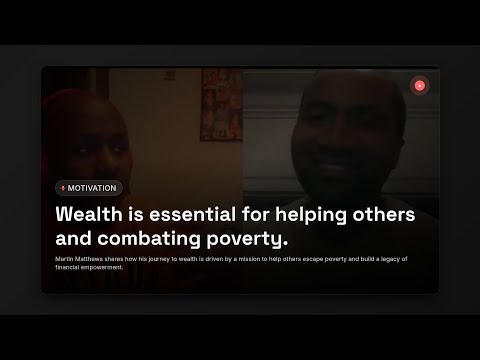
"I don't hustle for my first name, I hustle for my last name" — Martin Matthews builds wealth not for himself, but as a legacy for generations who haven't been born yet.
How Building Wealth Can Help Others Escape Poverty — Martin Matthews’ Inspiring Journey
Hustle Zone
Some guests come on Hustle Zone to talk tactics. Martin Matthews came on to talk about a hole in a pair of flip-flops — and by the end of the conversation with host Ryan Perez, it was clear the two things were the same story.
Matthews grew up in Liberia, one of the poorest countries in the world, and told Perez he spent his childhood watching a line of people form outside his family’s house — people coming to ask his father for financial help. He remembers sitting in the corner listening to their stories, some of them without enough money to eat the next day or take a sick parent to the hospital. One memory in particular has stayed with him: a father arriving with his two children, one of the kids wearing flip-flops with a hole worn through the bottom. Matthews took off his own flip-flops and gave them to the boy — the first time, he said, he remembers ever giving something away. He’s since written an ebook about it, called The Give 10 Project: How to Give More Than You Ever Dream Possible.
That scene, he told Perez, is the real reason he chases wealth. “I hated poverty,” Matthews said of his teenage self, arriving in America at 16 after his family survived Liberia’s civil war and sought refuge. He’d grown up watching American movies and assumed everyone in the U.S. was rich; getting there and discovering that wasn’t true sent him down what he called his real journey — learning how wealth actually gets built, and how it might be used to help the people he’d grown up watching struggle.
Much of the conversation circled around legacy rather than lifestyle. Matthews talked about a financial plan he’s put in place aimed at leaving significant assets to his children and grandchildren — an idea that, he admitted, confused at least one entrepreneur friend he shared it with. His reasoning traces back to his own family line: his father died at 59, his grandfather didn’t reach 50, his uncle didn’t reach 50, and his younger brother died at 25. “I don’t hustle for my first name,” he told Perez, “I hustle for my last name” — a line tied to the hashtag his family uses on their own livestream, #OnTheMoneyMatthews.
Perez pushed him on how that squares with people like Warren Buffett, who plan to give most of their wealth to charity rather than family. Matthews argued the two aren’t opposites — tools like foundations and incentive trusts, he explained, let wealthy families direct money toward causes they believe in while still keeping their children involved in decisions about it, rather than simply handing over a lump sum.
The episode also spent real time on Matthews’ marriage and how the family runs like a small operation. He met his wife, Chelsea, through mutual connections at a personal-development conference in San Diego; she’d studied for her Series 7 license at 18 before stepping away into real estate and motherhood, then returned to the financial industry so she could teach their son about money herself. The two now run a live show, work out, and run their business together — by Matthews’ account, they’re rarely apart.
That son, William, is 11, and the show-and-tell part of the episode belonged to him. Chelsea started teaching him money management at six, using a “wealth wallet” system where he divides earnings into different buckets. William’s first business was what the family calls the Snack Shack — he did informal market research among people in his father’s office, asking their favorite snacks, then used his own saved capital to buy and resell them from a small desk, doubling his money in a week and learning, along the way, what passive income looks like when the snacks keep selling while he’s back at school. His second venture is a video series teaching other kids about money, which he promotes himself on Facebook Live.
Perez, who opened the episode talking about reading and financial concepts with his own son, closed the conversation the way he closes most Hustle Zone episodes — with quick-fire questions. Matthews named Rudy as his favorite movie, cassava leaves as his favorite dish, and naysayers as his biggest pet peeve. By the end, Perez was already angling to get Chelsea and William booked on the show themselves — “we can’t do this one-sided,” he said, “you’re a unit.”
Lessons from this one
Kids grasp financial literacy fastest when it's tied to something they already want, not abstract numbers.
Martin Matthews said the financial industry is often "boring" and hard for kids to engage with, so he and his wife built lessons around their son William's love of Legos — teaching him to earn, then start a business, specifically so he could buy them himself.
Framing wealth-building as a multi-generational project, rather than personal enrichment, can be a powerful entrepreneurial motivator.
Matthews described a specific financial plan intended to pass significant assets to his children and grandchildren, tying it explicitly to his family's history of early deaths and his own belief that he must outdo what his father was able to leave him.
Early exposure to visible poverty can convert into a lasting drive to build wealth specifically in order to help others, not just for personal gain.
Matthews traced his ambition directly to childhood memories of people lining up outside his family's home in Liberia asking his father for money, including one boy whose flip-flops had a hole worn through them — an experience he says still shapes why he wants to be wealthy.
Shared values and aligned long-term goals between partners matter more in building a family enterprise than shared personality traits.
Matthews said he and his wife Chelsea are "in many ways opposites" but deliberately discussed what they each wanted in life before getting serious, and now run their business, a livestream, and their household together as what he called a genuine partnership rather than one person giving orders.
Giving children real operational experience — pricing, market research, using their own saved capital — teaches business concepts that lectures can't.
William, age 11, ran informal market research by asking people in his father's office about their favorite snacks, then used money from his own "wealth wallet" to buy and resell them, later grasping the concept of passive income when sales continued while he was away at school.
Sources
- Consumer Financial Protection Bureau, "Building Blocks to Help Youth Achieve Financial Capability: A New Model and Recommendations," 2016.
- Timothy G. Habbershon, Mattias Nordqvist & Thomas M. Zellweger (eds.), "Transgenerational Entrepreneurship: Exploring Growth and Performance in Family Firms Across Generations," Edward Elgar Publishing, 2010.
- Toyah L. Miller, Matthew G. Grimes, Jeffery S. McMullen & Timothy J. Vogus, "Venturing for Others with Heart and Head: How Compassion Encourages Social Entrepreneurship," Academy of Management Review, 2012.
- Margaret A. Fitzgerald & Glenn Muske, "Copreneurs: An Exploration and Comparison to Other Family Businesses," Family Business Review, 2002.
- Marilyn L. Kourilsky & William B. Walstad, "The Entrepreneur in Youth: An Untapped Resource for Economic Growth, Social Entrepreneurship, and Education," Edward Elgar Publishing, 2007.
- Runtime
- 1h 10m
- Show
- HustleZone
- Host
- Ryan Perez
Been through something like this?
HustleZone is conversations with people who built something out of the thing that was supposed to stop them. If that is you, say so.