How Leah Notarianni Overcame Doubt & Criticism To Achieve Entrepreneurial Success
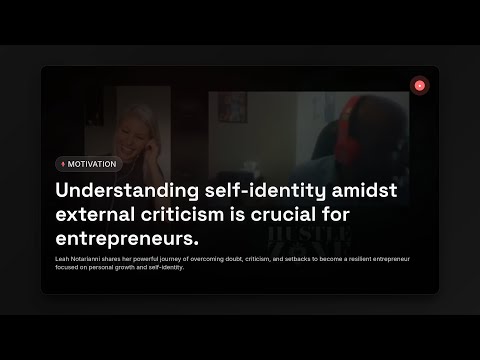
The moment you declare who you are, the doubt starts — and success doesn't remove it, it just teaches you to recognize it for what it is.
How Leah Notarianni Overcame Doubt & Criticism To Achieve Entrepreneurial Success
There’s a moment early in this episode of Hustle Zone where Leah Notarianni admits something most guests never do on a livestream: she wasn’t ready for the doubt that hit her that week. Host Ryan had asked about a post she’d written, and instead of a polished answer, Leah opened with the real one — that even after building multiple businesses and coaching other entrepreneurs, criticism can still catch her off guard. “I wasn’t ready for that,” she said, describing how she came home and called a friend who, hearing her rattled, asked her point blank: “Where did you go? Who is this person I’m talking to?”
That vulnerability sets the tone for the whole conversation. Notarianni is the founder of Soulful Hustlers, a brand built around a concept she says she developed after noticing a gap in the entrepreneurship space: people either chase personal development and lose their hustle, or they hustle nonstop and lose their connection to themselves. Her pitch is that the two aren’t in competition — “your business will never outgrow your personal development,” she told Ryan, and building one without the other eventually catches up with you.
Her own story explains why she landed on that idea. Notarianni was living on her own by sixteen and had her first daughter at twenty. She climbed fast in the corporate world, becoming a general manager by twenty-two — hired at a women’s-only fitness facility as an assistant manager, she was promoted within a month to cover a maternity leave and then hit 150% of the company’s quota in her first month running the location, a result she says she was asked to present to 150 other general managers. Then came a car accident: she was struck from behind at a dead stop by a vehicle going 80 kilometers an hour, leaving her with severe whiplash and back pain that forced her out of work, into lengthy rehabilitation, and ultimately out of that job. She told Ryan the crash relocated her seven times in two years and became the turning point where she decided she needed to “own” her own life rather than depend on a single employer for stability.
Much of the conversation returns to a theme Notarianni clearly thinks about a lot: being judged by appearance rather than substance. She told Ryan she was offered modeling and fitness-magazine contracts in her early twenties and turned them all down, saying she didn’t want to build a career — or a message to her daughters — around being “a pretty face” rather than a business strategist. She linked that directly to a broader point about criticism: people who doubt an ambitious goal, she argued, are often projecting their own limits onto you. “If they think that they can’t achieve it, they automatically put that on you,” she said, referencing an article she’d written on “ambition versus approval.”
The two also traded practical philosophy on failure, money, and relationships. Notarianni described failure as tuition — the price of learning what does and doesn’t work — and offered a line she said guides her: “don’t let success get to your head and failure get to your heart.” On people, she talked about “shedding” relationships that no longer fit as you grow, invoking the idea that some people are in your life “for a reason, a season, or a lifetime,” and advised paying attention to who does — and doesn’t — celebrate your wins. She also opened up briefly about dating as a divorced, single mother of two running a business, saying it currently isn’t her focus and that she’d rather stay open than force it.
Toward the end, Ryan asked lighter questions — favorite food (she’s vegan and loves stir-fries), pet peeves (inauthenticity and lying), and what she teaches her daughters about wealth. Her answer tied the whole episode together: wealth, she said, is happiness, love, financial abundance, health, and fulfillment, and she’d rather give her kids undivided attention than things. She mentioned spending close to $20,000 in a single year on her own personal development, framing it as proof that the “soulful” side of her philosophy isn’t just talk.
By the close, both host and guest were floating a follow-up conversation. For anyone building something and quietly absorbing criticism from the people closest to them, this episode is a reminder that the doubt doesn’t disappear once you succeed — you just get better at recognizing it for what it is.
Lessons from this one
Declaring an ambitious identity or goal tends to provoke doubt from the people closest to you, not just strangers.
Notarianni said that the moment you declare who you are or what you're going to do, 'the opposition will come and tell you that you're not that,' and that this criticism often comes from family members who are 'quote unquote supposed to love you the most.'
People often project their own perceived limits onto others when they doubt an ambitious goal.
She described telling someone she wanted to be a billionaire and being told she couldn't, framing this as projection: 'people often project their insecurities on other people,' tied to her article on 'ambition versus approval.'
A sudden physical injury can permanently change someone's relationship to job security and push them toward entrepreneurship.
After being hit by a car at a dead stop and suffering severe whiplash that cost her a well-paying management job, Notarianni said the experience taught her she 'needed to own my own life' since 'anything can happen in a moment.'
Consistent daily routines (morning rituals, mental 'priming') are described as the mechanism that builds resilience to criticism and doubt over time.
Notarianni said the person she is today is the result of 'daily practices,' citing that successful people commonly have morning rituals — meditation, audio books, prayer — and that 'priming your mind, feeding your mind good things every single day' is how she prepares for doubt and fear before they arrive.
Reframing failure as a necessary cost of growth, rather than a personal verdict, is presented as central to entrepreneurial resilience.
She argued that 'our success is actually built upon failures,' calling failure 'the tuition you pay for being an entrepreneur,' and offered the guiding line 'don't let success get to your head and failure to your heart.'
Sources
- Feather, N. T. (1989). Attitudes towards the high achiever: The fall of the tall poppy. Australian Journal of Psychology, 41(3), 239–267.
- Newman, L. S., Duff, K. J., & Baumeister, R. F. (1997). A new look at defensive projection: Thought suppression, accessibility, and biased person perception. Journal of Personality and Social Psychology, 72(5), 980–1001.
- Akkermans, J., Seibert, S. E., & Mol, S. T. (2018). Tales of the unexpected: Integrating career shocks in the contemporary careers literature. SA Journal of Industrial Psychology, 44, a1503.
- Wood, W., & Rünger, D. (2016). Psychology of Habit. Annual Review of Psychology, 67, 289–314.
- Shepherd, D. A. (2003). Learning from business failure: Propositions of grief recovery for the self-employed. Academy of Management Review, 28(2), 318–328.
- Dweck, C. S. (2016). Mindset: The New Psychology of Success. Random House.
- Runtime
- 57m
- Show
- HustleZone
- Host
- Ryan Perez
Been through something like this?
HustleZone is conversations with people who built something out of the thing that was supposed to stop them. If that is you, say so.