
How Joshua Therrian Turned Tragedy Into Triumph
Motivation, Wealth & Giving Back
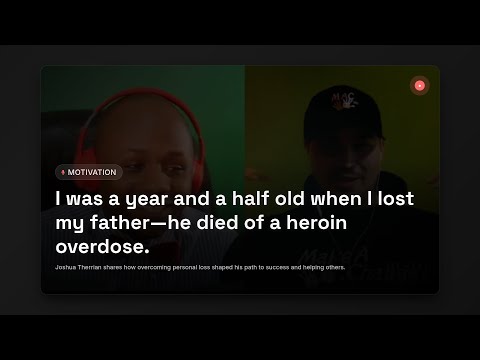
"Luck is the last thing that allowed everything that happened in my life to happen — it was hard work and determination, period."
How Joshua Therrian Turned Tragedy Into Triumph: Motivation, Wealth & Giving Back
Some guests arrive on the Hustle Zone with a business pitch. Joshua Therrian arrived with a testimony.
Host Ryan Perez opened this episode of Hustle Zone — his ongoing series about “the story leading up to the glory” — by promising that Joshua’s story would look familiar to anyone who thinks a hard childhood disqualifies them from becoming an entrepreneur. What followed was one of the more unguarded conversations the show has aired.
Losing both parents to addiction
Joshua was a year and a half old when his father died of a heroin overdose. He never got to know him. Growing up, money and stability were scarce, and so was confidence — he recalls being told in third grade that he smelled bad, the result of not having consistent hygiene at home while his mother struggled with substance abuse of her own.
The turning point came at age 9, when his aunt and uncle took him in. He credits them — especially his aunt, who later homeschooled him starting in seventh grade and battled a serious heart condition of her own — with showing him what love and faith looked like for the first time. He calls them “some of my heroes.”
Joshua went on to Fitchburg State University, where he studied exercise science with a business minor and pitched for the college baseball team. Then, at 19, while he was still in college, he got the call that his mother had also died of a heroin overdose — six years ago this past January, just days before this conversation was recorded. He describes the period afterward not as depression but as a steady, quiet mourning, one he says his faith carried him through. His life motto, he says, is Romans 8:28 — the belief that everything in his past, however painful, is being worked toward something good.
Building a family fast
That same year, Joshua met the woman who would become his wife — his high school sweetheart, even though he was already in college. Not long before their wedding, the couple took in his two nieces, an unplanned and, in his words, hard-to-put-into-words turning point that made them parents before they were even married. They married in June 2014; Joshua became an insurance sales agent that July; they bought their first house that October. A third child, a boy named JoJo, joined the family in March 2015.
From there, Joshua and his wife built a real estate investment business — buying, rehabbing, and renting properties for passive income. In June 2016, frustrated by how slow early real estate income can be, he decided not to wait for success to start living his purpose. That decision became Make A Change Inc, a nonprofit built around meaningful memories, education, and faith-based and financial education for kids who’ve been through circumstances like his own. The organization runs a domestic arm supporting kids in foster care and tough home situations in the U.S. and Canada, and Joshua described plans for an international “orphan committee” focused on mission trips and orphanage-building in Kenya.
“Luck is the last thing”
Asked how he’d respond to people who chalk his success up to luck or privilege, Joshua didn’t hesitate: “Luck is the last thing that allowed everything that happened in my life to happen. What it was, was hard work and determination, period.” He described working roughly 80 hours a week as a college student — while also carrying a full course load and preparing to get married — and said that pace has essentially continued ever since, with current weeks running 80 to 100 hours between his income-generating work, running the nonprofit, and building long-term wealth through real estate.
He also talked about his book, which walks readers through doubling their income, with a favorite chapter devoted entirely to identifying your “why.” For Joshua, that why is explicit: faith, family, and Make A Change. Money, he argues, isn’t the problem — “loving money is what’s evil,” he said — and he frames financial freedom as resting on four pillars: faith, family, health, and money, meant to fund generational stability rather than personal indulgence alone.
Outside of the hustle, Joshua kept it simple: baseball, Sunday NFL (he’s a Tom Brady fan), and church. He picked Pepsi over Coke and Michael Jackson over Prince — and admitted that, fun aside, most of his waking hours still go toward the same mission that got him here.
Lessons from this one
Losing both parents to addiction became the explicit source of Joshua's drive rather than an excuse to quit.
The foundational CDC-Kaiser Adverse Childhood Experiences (ACE) Study established household substance abuse as one of ten major categories of childhood adversity and documented a strong dose-response relationship between such adversity and adult outcomes. The study itself is about risk, not resilience — it does not measure or claim that adversity reliably produces drive or 'post-traumatic growth'; that reframing is well documented in later resilience literature but Joshua's account here is best read as one person's lived testimony of turning risk into motivation, not a tested general finding.
One stable, loving caregiver relationship redirected an entire life trajectory.
A Cochrane systematic review of kinship care (children placed with relatives after removal for maltreatment) analyzed over 100 studies covering hundreds of thousands of children and found kinship placement associated with better behavioral and well-being outcomes than non-relative foster care in most comparisons — consistent with Joshua's account of his aunt and uncle's home changing his trajectory, though the review speaks to population-level patterns in kinship placement generally, not to this individual case.
Treating money as a purpose-driven tool, not an end in itself, reframes how people pursue wealth.
A classic and heavily-cited study in personality and social psychology found that people who center their lives on financial success as a primary aspiration (an extrinsic, self-as-end goal) report lower well-being than those oriented around purpose-driven or self-actualizing goals — a research line directly relevant to Joshua's distinction between 'loving money' and using money as a tool for faith, family, health, and a mission. The study is about goal orientation and well-being broadly; it doesn't test his specific four-pillar framework or nonprofit funding strategy.
Sustained, unusually high work volume — not luck — is the mechanism guests like this repeatedly point to for their results.
Labor economics research on working hours finds that productivity per hour declines sharply as weekly hours climb — output per hour drops materially between roughly 50 and 70 hours a week, such that very long hours yield diminishing and eventually flat returns on total output. This is a useful reality check rather than a confirmation: it supports that heavy effort matters but cautions against reading 80-100 hour weeks as a straightforwardly optimal or linearly scaling driver of results the way the claim implies.
Pencavel, J. (2015). "The Productivity of Working Hours." The Economic Journal, 125(589), 2052-2076.
People who lived through a hardship are well positioned to build the support system they wish they'd had.
A meta-analysis of peer support interventions (support delivered by people with relevant lived experience) found they improved depression symptoms more than usual care alone, part of a broader literature showing lived-experience-based support models can produce measurable benefits in mental health and social-service contexts. This supports the general premise behind Make A Change Inc.'s design, but was not conducted on foster-care mentoring or faith-based financial education programs specifically.
Sources
- Felitti VJ, Anda RF, Nordenberg D, Williamson DF, Spitz AM, Edwards V, Koss MP, Marks JS (1998). "Relationship of Childhood Abuse and Household Dysfunction to Many of the Leading Causes of Death in Adults: The Adverse Childhood Experiences (ACE) Study." American Journal of Preventive Medicine, 14(4), 245-258.
- Winokur, M., Holtan, A., & Batchelder, K.E. (2014). "Kinship care for the safety, permanency, and well-being of children removed from the home for maltreatment." Cochrane Database of Systematic Reviews.
- Kasser, T., & Ryan, R. M. (1993). "A dark side of the American dream: Correlates of financial success as a central life aspiration." Journal of Personality and Social Psychology, 65(2), 410-422.
- Pencavel, J. (2015). "The Productivity of Working Hours." The Economic Journal, 125(589), 2052-2076.
- Pfeiffer, P. N., Heisler, M., Piette, J. D., Rogers, M. A., & Valenstein, M. (2011). "Efficacy of peer support interventions for depression: A meta-analysis." General Hospital Psychiatry, 33(1), 29-36.
- Runtime
- 50m
- Show
- HustleZone
- Host
- Ryan Perez
Been through something like this?
HustleZone is conversations with people who built something out of the thing that was supposed to stop them. If that is you, say so.