How Neurodivergent Creators Thrive
Growth, Leadership & Authentic Expression
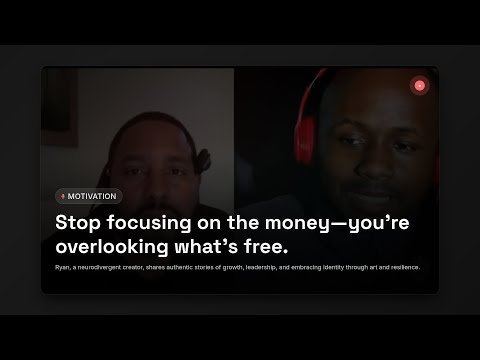
As Pierre Evans put it on the show: there's more power in the pull than there is in the push.
“# How Neurodivergent Creators Thrive: Growth, Leadership & Authentic Expression\n\nHustle Zone, hosted by Ryan Perez\n\nRyan Perez opened this episode of Hustle Zone the way he opens most of them — with an update on the show’s own growth (a recent IMDb listing, a clothing line, and plans for a magazine and a "Hustle Zone TV" channel) before bringing back a familiar face: Pierre Evans, founder of re-empower, who had first appeared on the show back in episode five to share his personal story. This time, Ryan wanted the follow-up — what Pierre had actually built since then.\n\nThe update was substantial. Pierre said his book — an autobiography walking through his life and the tools he used to get where he is — was finally complete after "a lot of ups and downs" with edits going back and forth, and he expected it in hand around the first week of July. On the speaking side, he described a fast-growing calendar: dates in Toronto and Winnipeg in September, and a call that had just come in about two cities in New Zealand and one in Australia early the following year. He was candid that the growth wasn’t effortless — people who once turned down his offers to speak for free were now calling him, still hoping for the free version, which he took as a sign of how far things had moved.\n\nAsked about his biggest current challenge, Pierre didn’t point to money or bookings — he pointed to himself. For a long time he ran re-empower as what he called a "one-man team," and he’d only recently brought on an assistant. The harder part, he said, wasn’t finding help — it was actually letting go of the pieces he’d been personally nursing. He compared over-controlling a hire to refusing to let your own child fly alone: at some point you have to hand over the parts of the business you’re not built to master and trust someone else to run them, or the company simply stops growing.\n\nThat led into a longer back-and-forth with Ryan about trust — Ryan shared his own experience being pushed into a management role at a cell phone sales job by a friend named Louise, and admitted he’s struggled to fully hand over things like social media passwords to assistants he’s hired since. Pierre’s answer was blunt: if you don’t trust someone enough to hand them real responsibility, they shouldn’t be on the team at all, and refusing to trust anyone after a few bad hires just keeps you stuck.\n\nThe conversation moved through leadership more broadly, touching briefly on the political drama in the news at the time as a jumping-off point. Pierre’s definition of a leader was someone willing to do the work themselves rather than just manage a plan from a distance, and someone grounded enough in their own beliefs to hold a decision even when it draws criticism — while still being willing to fix things when they were genuinely in the wrong.\n\nAsked where his own thinking comes from, Pierre named his mentors Eric Thomas and CJ specifically because they’re still growing themselves, rather than mentors who’ve plateaued. He also talked about studying Jay-Z’s career arc over time, Sean "Puff" Combs’s early years running errands and getting coffee before his rise, and Warren Buffett’s approach to business as sources of insight, along with a nod to John Maxwell on knowing when to lead a room and when to follow in it.\n\nOn team-building, Pierre laid out a simple framework: identify the areas you’re strong in, identify where you’re weak, commit to mastering one of your strengths, and then recruit people whose strengths cover your gaps — while your strengths cover theirs. He traced that philosophy back to lessons learned playing basketball and football as a kid, including being benched repeatedly by a coach for not passing the ball, which is where he says he actually learned what being part of a team means.\n\nThe episode closed on persistence — Pierre’s line that there’s "more power in the pull than there is in the push," and that most people give up long before they’d actually break. He pointed listeners to his Fifth Quarter Living movement and its Saturday morning calls, and to re-empower online, before Ryan wrapped with updates on Hustle Zone’s own magazine and the requirements — headshots, release forms, an application — for anyone looking to be featured.”
Lessons from this one
Real delegation means letting go of control, not just adding headcount.
Pierre Evans described his biggest challenge as being a "one-man team" and said the hard part of finally hiring an assistant was resisting the urge to micromanage, comparing it to trusting someone else to fly your own child on a plane.
Effective teams are built by pairing complementary strengths and weaknesses, not by cloning your own skill set.
Pierre laid out a framework of identifying your five strengths and five weaknesses, mastering one strength, and recruiting people whose strengths fill your specific gaps while your strengths fill theirs.
The most useful mentors are the ones still actively growing, not the ones who've plateaued.
Pierre explained he chose to keep following Eric Thomas and CJ specifically because they haven't stopped growing themselves, contrasting that with mentors who reach a comfortable plateau and stop offering new value once a mentee catches up.
Early team-sport experiences can shape adult leadership and collaboration habits.
Pierre traced his understanding of teamwork back to being repeatedly benched in basketball and football as a kid for not passing the ball, which he says is where he actually learned to prioritize the team over individual performance.
Sustainable growth is a function of persistence over time, not short bursts of effort.
Pierre argued that people often give up on a goal after a short push and lose the trust of those backing them, saying it can take years of consistent effort to rebuild belief, and summarized his philosophy as "there's more power in the pull than there is in the push."
Sources
- Noam Wasserman (2008), "The Founder's Dilemma," Harvard Business Review
- R. Meredith Belbin, Belbin Team Roles model (from 'Management Teams: Why They Succeed or Fail,' 1981)
- Eby, L. T., Allen, T. D., Evans, S. C., Ng, T., & DuBois, D. L. (2008). "Does mentoring matter? A multidisciplinary meta-analysis comparing mentored and non-mentored individuals." Journal of Vocational Behavior, 72(2), 254-267.
- Eime, R. M., Young, J. A., Harvey, J. T., Charity, M. J., & Payne, W. R. (2013). "A systematic review of the psychological and social benefits of participation in sport for children and adolescents." International Journal of Behavioral Nutrition and Physical Activity, 10:98.
- Duckworth, A. L., Peterson, C., Matthews, M. D., & Kelly, D. R. (2007). "Grit: Perseverance and passion for long-term goals." Journal of Personality and Social Psychology, 92(6), 1087-1101.
- Runtime
- 50m
- Show
- HustleZone
- Host
- Ryan Perez
Been through something like this?
HustleZone is conversations with people who built something out of the thing that was supposed to stop them. If that is you, say so.