
How Natasha B Russell Overcame Bullying to Build Confidence & Inspire Others
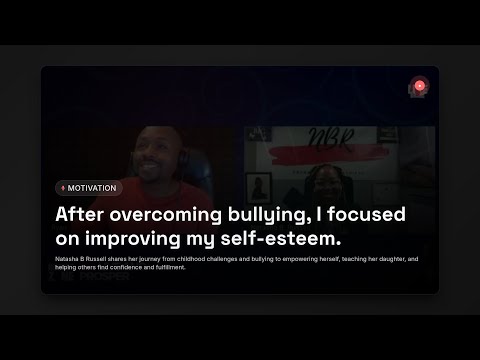
Natasha B Russell's message to the girl who once felt broken by bullying and self-doubt: "You are enough."
How Natasha B Russell Overcame Bullying to Build Confidence & Inspire Others
On this episode of Go Live and Prosper (the rebranded successor to Hustle Zone), host Ryan Perez sits down with Natasha B Russell — president and CEO of NBR Strategic Solutions Inc., a Calgary-based public relations agency, and a certified transformation coach and motivational speaker who works with men, women, and youth around the world. Perez opens by admitting the two had crossed paths for years in Calgary’s business and Black content-creator circles before ever properly meeting, and the conversation that follows is less an interview than an unhurried conversation about where confidence actually comes from.
Natasha’s story starts around age seven, when she developed what she describes as a rare form of “epilepsy of the mouth” — seizures confined to her mouth rather than her whole body, which doctors told her family was unusual. She saw numerous specialists and was put on trial medications; within two years the seizures stopped for good. But the medication left her with significant weight gain, and as a child wearing a medical-alert bracelet, she was bullied and teased. The real turning point, she says, came at age 11 in church, when a pastor’s line — that she was “fearfully and wonderfully made” — reframed how she saw herself. From there, she began feeding herself affirmations and rebuilding her self-esteem.
That confidence showed up early in unconventional ways. At 18, while many of her friends went into retail or fast food, Natasha talked her way into law firm jobs without a legal assistant diploma, betting on confidence and her ability to learn. She eventually earned a Bachelor of Communications in public relations, with honours, from Mount Royal University, and moved into the energy sector doing media and communications work. The pay was good, she says, but something was missing — the work wasn’t fulfilling her. That gap led her toward life coaching and motivational speaking, certifications she layered onto her PR background to build the hybrid practice she runs today.
A recurring theme is the specific weight of being a Black woman in Calgary’s corporate spaces. Natasha describes encountering microaggressions in law firms and later in energy, and being made to feel there was an invisible ceiling — “you’re only going to get so far.” Rather than staying limited to the local market, she expanded her client base into the United States. She also reframes something many would call a disadvantage: being the only woman of color in a room of a thousand or two thousand professionals, she says, is her superpower, not a threat.
Perez and Natasha also talk candidly about how confidence can be misread as intimidation, both professionally and personally, and how she’s had to learn to be more vulnerable — sharing her struggles rather than projecting only polish — to build real connections instead of pushing people away.
Parenting runs through the whole conversation. Natasha talks about raising her seven-year-old daughter, Natalia, who is often the only child of color in her class, and about having hard conversations early — including explaining the history of slavery after Natalia asked about a protest they watched together. She also describes deliberately not repeating her own father’s perfectionism (he once questioned her 97% grade), instead teaching Natalia about responsibility, saving, and the value of money, down to letting her decide whether a $16 pancake maker from her own savings is worth it.
The episode closes with a look at what Natasha is building next: a workbook called Strategize for My Success, group coaching programs called “Boss Up” and “Communicate with Confidence,” and new work as oversight consultant for the Calgary Black Chambers, where she’s helping develop a youth mentorship program. She recounts asking a room of roughly 15 kids, ages 9 to 19, how many considered themselves leaders — only one raised a hand — and says that’s exactly the mindset she wants to help shift.
Asked what she’d tell the 11-year-old girl who felt she wasn’t good enough, Natasha doesn’t hesitate: “You are enough.” It’s the same message, she says, she now offers to anyone who feels like they don’t belong in the space they’ve chosen.
Lessons from this one
Confidence forged through childhood adversity can become a professional differentiator later in life.
Natasha describes overcoming a rare seizure condition, related weight gain, and bullying as a child, and pinpoints a pastor's phrase at age 11 as the moment her mindset shifted toward self-acceptance and confidence-building.
Reframing 'being the only one in the room' as an advantage rather than a liability can change how a person shows up professionally.
Natasha explicitly calls being the only woman of color in rooms of a thousand or more professionals her 'superpower,' rather than treating it as a threat or disadvantage. Note: the study below documents solo status as a performance-undermining stressor via stereotype threat; it supports why the reframe matters, not that reframing itself was tested as an intervention.
Talking to children openly about difficult history and about money builds resilience and financial literacy earlier than many parents attempt.
Natasha describes explaining the history of slavery to her seven-year-old after a protest came up, and teaching her daughter to weigh purchases against her own savings, such as deciding whether a $16 toy is worth the money in her account.
Vulnerability, not projected toughness, is what breaks down the perception of being 'intimidating.'
Natasha says confidence is sometimes read by others as intimidation, and that she's had to learn to be more vulnerable and share her personal struggles in order to build genuine connection rather than distance. Note: this foundational academic study establishes vulnerability/shame research as a legitimate field (Brené Brown's own peer-reviewed grounded-theory work) but does not test the specific 'intimidation' perception described here.
Asking 'what's the why beneath the why' helps distinguish purpose-driven ambition from simply chasing money.
Natasha describes pushing clients who say they just want to make money to identify a deeper purpose, framing this as the key difference between imitation and genuinely fulfilling work, especially given the unpredictable income of entrepreneurship.
Sources
- Tedeschi, R. G., & Calhoun, L. G. (2004). Posttraumatic Growth: Conceptual Foundations and Empirical Evidence. Psychological Inquiry, 15(1), 1-18.
- Sekaquaptewa, D., & Thompson, M. (2003). Solo status, stereotype threat, and performance expectancies: Their effects on women's performance. Journal of Experimental Social Psychology, 39(1), 68-74.
- Hughes, D., Rodriguez, J., Smith, E. P., Johnson, D. J., Stevenson, H. C., & Spicer, P. (2006). Parents' Ethnic-Racial Socialization Practices: A Review of Research and Directions for Future Study. Developmental Psychology, 42(5), 747-770.
- Drever, A. I., Odders-White, E., Kalish, C. W., Else-Quest, N. M., Hoagland, E. M., & Nelms, E. N. (2015). Foundations of Financial Well-Being: Insights into the Role of Executive Function, Financial Socialization, and Experience-Based Learning in Childhood and Youth. Journal of Consumer Affairs, 49(1), 13-38.
- Brown, B. (2006). Shame Resilience Theory: A Grounded Theory Study on Women and Shame. Families in Society: The Journal of Contemporary Social Services, 87(1), 43-52.
- Ryan, R. M., & Deci, E. L. (2000). Self-Determination Theory and the Facilitation of Intrinsic Motivation, Social Development, and Well-Being. American Psychologist, 55(1), 68-78.
- Karimi, S., & Reisi, S. (2023). Linking Entrepreneurial Passion to Entrepreneurs' Life Satisfaction: The Mediating Role of Basic Psychological Needs Satisfaction and Work Engagement. FIIB Business Review, 15(4), 604-617.
- Runtime
- 1h 11m
- Show
- HustleZone
- Host
- Ryan Perez
Been through something like this?
HustleZone is conversations with people who built something out of the thing that was supposed to stop them. If that is you, say so.