How Military Struggles Sparked My Entrepreneurial Journey – Abdul Mohammed’s Inspiring Story
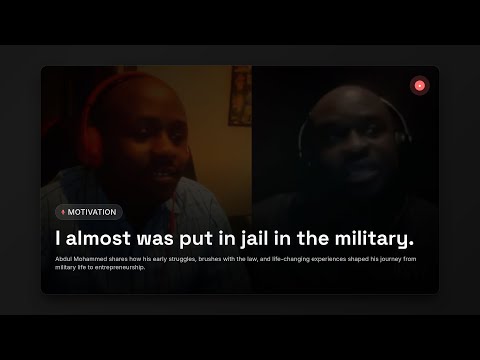
Entrepreneurs are some of the bravest people alive, Abdul Mohammed argues, because unlike employees who just show up for a paycheck, they have to build the entire system that creates the money first — and only then hope the reward follows.
From a Somalia Tarmac to a $20 Lawn-Mowing Hustle: Abdul Mohammed’s Case for Fearless Entrepreneurship
Some episodes of Hustle Zone open with a pitch. This one opened with a confession.
Before he even introduced his guest, host Ryan Perez — owner and founder of Bow Tie Kreative — told the room that starting his own agency had, if he was honest, been less of a calling and more of a crutch. He’d started the business right after a breakup, he said, and used it to stay busy rather than deal with what he was actually going through. He took on every job himself — accountant, admin, graphic designer, web developer — not because the business needed him to, but because he needed something to do. It took his guest, Abdul Mohammed, asking the kind of pointed questions people “shrug off because you don’t want to hear the truth,” to make him see it. Perez credited that conversation with pushing him to rebuild his focus, his brand, and his plans to eventually hand the business to someone else.
That guest turned out to have his own origin story worth the confession. Mohammed — a serial entrepreneur, author, former reality TV participant, and host of a YouTube channel with a combined 25,000-plus subscribers across YouTube and Facebook — traced his first real hustle back to a humiliating night at a party in Memphis, Tennessee. He showed up in bell-bottom jeans with pins holding the hems, standing against a wall trying to hide, while other kids his age wore clothes he couldn’t afford. He decided it would never happen again. The next week, he and some friends borrowed lawnmowers from their mothers and knocked on doors charging $20 a yard. Within weeks they had around 50 accounts.
That instinct to build rather than wait carried into his time in the military, where he was stationed in Cuba and deployed to Somalia. He described flying into Somalia escorted by an Apache helicopter because planes were being shot at, and spending two weeks unable to sleep through nightly gunfire near the compound. He said reaching a point where he no longer feared death made everything afterward feel easier by comparison — including, he admitted on air for what he said was the first time, a close call where a lieutenant overheard him negotiating to sell military tires to Somali locals, a scheme that could have landed him in jail for years. It was also in Cuba, in 1995, that he converted to Islam after months of conversation with a fellow serviceman whose discipline and knowledge impressed him.
Mohammed’s business instincts show up again in a story he says he “couldn’t make up”: buying goods in LA to resell on the Vans Warped Tour, only to find his own wholesalers undercutting him at the same events. A tip from a friend sent him and a buddy to Hong Kong with almost no plan, which turned into a visa run into mainland China, navigating cities with only a business card written in Cantonese to guide cab drivers. “I started business off in the most fearful way at the beginning,” he said, “most people probably would do that at the end.”
Much of the conversation returned to a theme: ADHD and dyslexia as assets rather than deficits. Mohammed said most entrepreneurs he’s met have ADHD-type traits — restlessness, difficulty with routine, a hunger for stimulation — and argued it’s “not a disability, it’s just that we may not know how to use our superpowers.” Perez, who is dyslexic, agreed, describing how reading multiple sources instead of one book gives him a different, deeper grasp of a problem.
The pair also traded practical routines: Mohammed’s 3:45 a.m. ritual of water, a bath, and audio programs to quiet his mind before the day starts; both men noted that their best ideas tend to arrive in the shower or half-asleep, something Mohammed tied back to the historical experiments of Dr. Elmer Gates. On marketing, Mohammed — mid-way through a batch of certifications with Ryan Deiss — laid out a simple rule: give away roughly 90 percent value through daily content, and ask for the sale only about 10 percent of the time, but always build toward an actual product.
The episode closed on lighter notes — chicken curry as a favorite dish, Tony Robbins’ I Am Not Your Guru as a go-to documentary, The $100 Startup as the book club’s latest read — before Mohammed left listeners with a blunt closing line: if you hate your job, don’t be afraid of the entrepreneurial road just because it will “beat you up.” Failure, he said, just means you don’t have enough information yet.
Lessons from this one
ADHD-type traits show up disproportionately among entrepreneurs and can be reframed as an asset rather than a disability.
Mohammed said most entrepreneurs he's encountered show ADHD-type behavior — disorganization, rapid idea generation, low tolerance for routine — and cited Richard Branson's dyslexia and ADHD as an example, arguing it's 'not a disability, it's just that we may not know how to use our superpowers.'
Building a business as an emotional coping mechanism, rather than a real system, can quietly stall its growth.
Perez admitted Bow Tie Kreative began as a way to stay busy after a breakup, and that he took on every operational role himself rather than delegating, until Mohammed's questioning pushed him to rebuild the business with actual structure.
Quiet, low-stimulation routines — meditation, showers, half-asleep states — appear to be reliable triggers for creative ideas.
Mohammed described a pre-dawn ritual of water, a bath, and audio programs to quiet his mind, and both he and Perez noted their best ideas arrive in the shower or while falling asleep, referencing Dr. Elmer Gates' historical sensory-deprivation experiments for idea generation.
Deliberately choosing the fearful path early can build a resilience that makes later challenges feel manageable.
Mohammed framed his most frightening experiences — a near-planless business trip through Hong Kong and mainland China, and reaching a point in Somalia where he no longer feared death — as what set him up for everything that followed, echoing the book 'Feel the Fear and Do It Anyway.'
Sustainable content marketing runs on giving away the large majority of value for free and asking for the sale only rarely — but only if a real product backs it up.
Mohammed described a roughly 90/10 value-to-ask ratio for daily content (podcasts, blogs, videos) tied to a marketing funnel, warning that content without a product behind it means 'you're basically wasting time.'
Sources
- Wiklund, J., Patzelt, H., & Dimov, D. (2016). Entrepreneurship and psychological disorders: How ADHD can be productively harnessed. Journal of Business Venturing Insights, 6, 14-20.
- Rauch, A. (2020). Well-being of entrepreneurs: The thin line between work engagement and workaholism. Journal of Enterprising Culture, 28(2), 105-124.
- Baird, B., Smallwood, J., Mrazek, M. D., Kam, J. W. Y., Franklin, M. S., & Schooler, J. W. (2012). Inspired by distraction: Mind wandering facilitates creative incubation. Psychological Science, 23(10), 1117-1122.
- Brooks, A. W. (2014). Get excited: Reappraising pre-performance anxiety as excitement. Journal of Experimental Psychology: General, 143(3), 1144-1158.
- Regan, D. T. (1971). Effects of a favor and liking on compliance. Journal of Experimental Social Psychology, 7(6), 627-639.
- Runtime
- 1h 05m
- Show
- HustleZone
- Host
- Ryan Perez
Been through something like this?
HustleZone is conversations with people who built something out of the thing that was supposed to stop them. If that is you, say so.