Knockout Fear Fast
Dave Daley’s Secrets to Motivation & Authentic Success
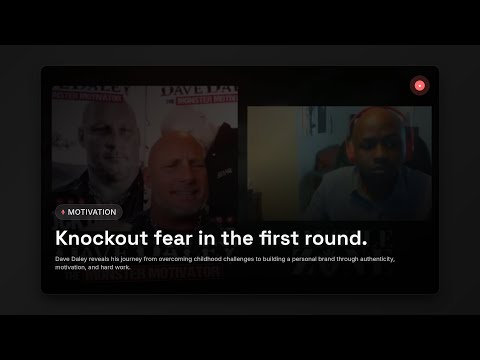
Dave Daley's core message: your self-image is something "you could build it up, you could tear it down, but you cannot outperform it."
Knockout Fear Fast: Dave Daley’s Secrets to Motivation & Authentic Success
On this episode of Hustle Zone, host Ryan Perez sits down with Dave Daley — “the monster motivator” — for a conversation that moves fast, gets personal, and doesn’t pull a single punch. By the end, Daley admits the pace even surprised him: “I hope you enjoyed the Hustle Zone. I don’t know if you knew what you were expecting.”
Daley opens by describing a routine that hasn’t changed in years: his alarm goes off at 4:30 a.m., seven days a week, and he’s at the gym. “That’s my zen,” he says. It’s not a weekday-only discipline, either — when his assistant, Cindy, apologized for calling him on a Sunday afternoon, he told her plainly, “I have no boundaries… Sunday is just like a Tuesday.” Between his motivational speaking business and a fire restoration company he also runs, Daley describes himself less as someone chasing balance and more as someone who’s found his own version of it: “that’s my oxygen, that’s what keeps me interested.”
But the energy wasn’t always pointed in a productive direction. Daley tells Perez that school failed him long before he found his footing. He was left back in second grade, diagnosed with ADD and a learning disorder, and never graduated high school. At 19, he was sitting in a jail cell “looking at 8 to 10” years if things didn’t break his way. He credits wrestling — which he started in fourth grade — as an early clue that he simply learned differently than a “cookie cutter” classroom allowed for. Baseball, by contrast, bored him “out of my mind.”
That thread runs through the whole episode: Daley argues that everything maps back to self-image. “You could build it up, you could tear it down, but you cannot outperform it,” he tells Perez, insisting that personal development should be taught to kids from day one, before the world convinces them not to expect much from themselves.
The entrepreneurial stories follow the same arc. His first business was a public adjusting firm he ran with a partner — Daley on sales, his partner on the back-end adjusting — funded entirely by sweat equity, with no loans and no family money behind it. Later, in 2008, he left New Jersey for San Diego and bought a struggling sports nutrition store in North County Vista in the middle of what he calls “a depression, not a recession.” Within a year and a half he’d tripled its numbers, and he sold it in 2012. He describes entrepreneurs as people carrying “fog lights” that let them see a destination no one around them can make out yet — and leans on a line from Martin Luther King Jr. that he returns to often: “you don’t have to see the whole staircase, you just got to see the next step.”
Asked what actually drives him, Daley points to personal development, which he says changed his life about 17 years ago after he was introduced to it through marriage counseling. He’s careful to frame himself modestly here — “I’m not a mentor, I’m not a coach… I’m a student that’s sharing what was taught to me” — even as he acknowledges his branding is deliberately loud. His rule, he says, is simple: “never let them forget you.” Every post that goes out under the Monster Motivator name, he says, comes live from his own phone in real time, not scheduled through a tool like Hootsuite or Buffer.
The conversation turns notably candid when Perez asks who keeps Daley balanced. His answer: honestly, not many people. A handful of close friends, a small family, and otherwise, in his words, “I just do me.” He credits “motion therapy” — walking his dog, driving, staying physically in motion — as essential to how he thinks, admitting that sitting still in an office is one of the hardest things for him to do.
Daley also opens up about the end of his 17-year marriage, calling the way he and his ex-wife handled the split — dividing the business and properties without attorneys, and still staying close with her family — the thing he’s proudest of in his life, “business or personal, bar none.” He ties it directly back to the same personal development work that reshaped his self-image years earlier.
The episode closes, fittingly, with the two of them doing the “Monster Motivator Roar” live on air, and Daley pointing listeners to his book, Knockout Fear in the First Round, available on Amazon.
Lessons from this one
A struggling school record doesn't predict entrepreneurial capability.
Daley describes being left back in second grade, diagnosed with ADD and a learning disorder, and never graduating high school, yet he built and sold multiple businesses and argues classroom conditioning taught him the opposite of what actually served him.
Self-image, not circumstance, is what caps or unlocks performance.
Daley states directly that self-image "you could build it up, you could tear it down, but you cannot outperform it," and ties his own turnaround to rebuilding how he saw himself after a difficult adolescence.
A strong enough personal 'why' sustains effort through fear and hardship.
Daley says that when your why becomes bigger than you, you become unstoppable, using the example of a single mother working multiple jobs because her family is her why.
Emotional intelligence can matter more than credentials in real-world performance.
Daley says he has hired degreed engineers who couldn't do basic consistent work, and credits EQ over IQ for his own success, citing 'Emotional Intelligence 2.0' by Travis Bradberry.
Consistent, unfiltered authenticity builds stronger audience trust than polished, scheduled messaging.
Daley says all his social posts go out live from his phone in the moment rather than pre-scheduled through tools like Hootsuite or Buffer, arguing that realness and consistency are what separate him from people who fade out.
Sources
- Wiklund, J., Patzelt, H., & Dimov, D. (2016). "Entrepreneurship and psychological disorders: How ADHD can be productively harnessed." Journal of Business Venturing Insights, 6, 14-20.
- Bandura, A. (1977). "Self-efficacy: Toward a unifying theory of behavioral change." Psychological Review, 84(2), 191-215.
- Ryan, R. M., & Deci, E. L. (2000). "Self-determination theory and the facilitation of intrinsic motivation, social development, and well-being." American Psychologist, 55(1), 68-78.
- Joseph, D. L., & Newman, D. A. (2010). "Emotional intelligence: An integrative meta-analysis and cascading model." Journal of Applied Psychology, 95(1), 54-78.
- Audrezet, A., de Kerviler, G., & Guidry Moulard, J. (2020). "Authenticity under threat: When social media influencers need to go beyond self-presentation." Journal of Business Research, 117, 557-569.
- Runtime
- 49m
- Show
- HustleZone
- Host
- Ryan Perez
Been through something like this?
HustleZone is conversations with people who built something out of the thing that was supposed to stop them. If that is you, say so.