How Tazroc Turned Adversity into Art
Lessons in Creativity & Justice
For Taz Rock, art has no expiration date — it's simply a voice, "like music on a wall," that he'll keep speaking as long as his hands keep working.
How Taz Rock Turned Adversity into Art: Lessons in Creativity & Justice
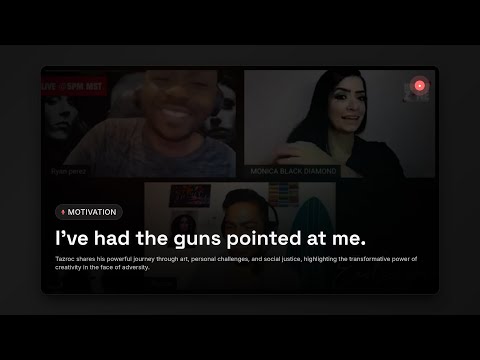
Brian “Taz Rock” Garcia has spent 18 years building a name in the Los Angeles graffiti scene, but on this episode of Hustle Zone, host Ryan Perez and co-host Monica caught him at 7 a.m. in Indonesia — coffee in hand, thousands of miles from the West Coast walls that made him famous. What followed was a wide-ranging conversation that moved from a childhood story about a prison-bound uncle to a hard-edged discussion of policing, race, and what it means to hold onto your “authority” in an encounter with a cop.
From a Prison Letter to a Life in Paint
Taz Rock traces his art back to something small: his mother noticed he was always drawing and asked him to send some pictures to his uncle, who — unbeknownst to young Taz — was in prison and rarely got mail. The drawings he sent back amazed him, and that exchange, paired with having two creative parents, kept him drawing through childhood. By the time he hit his early teens he’d been pulled into airbrushing clothes and cars for family and friends, but it was seeing large-scale graffiti pieces on walls in LA — after growing up in Oregon — that changed everything. “That’s what I’m doing,” he remembers thinking. He also spent nearly a decade BMX freestyling and B-boying competitively, but eventually made a deliberate choice: rather than being “mediocre at a few things,” he decided to commit fully to visual art, reasoning that his body had limits for physical disciplines but his hands could keep painting indefinitely.
Art as Voice, Not a Formula
Asked about the purpose of art, Taz Rock described it simply as a voice — something internal that only he can see and translate onto a wall or canvas. He compared a mural’s effect on a passerby to the difference between disliking a genre of music and hearing your favorite song: some art just speaks to you. He was candid that sticking to one signature style is often the surest path to commercial fame, but said doing the same thing repeatedly would strip his work of purpose — he’d rather chase new ideas, from skulls and Day of the Dead–style women’s portraits rooted in his Chicano culture to a peacock a friend once requested.
His influences shifted geographically over time: early exposure came through television and the graffiti documentary Style Wars, pulling him toward East Coast letter work, but once he connected with West Coast and San Diego artists — he named Slick, Hex, Saki, Quazar, Zodiac, and Persue — who were pushing graffiti toward photorealistic portraiture, he says he never looked back. His crew, Defcon 5, stood out to him because its members treated the culture as a lifelong commitment rather than a passing trend.
Legacy, Murals, and the Vandalism Question
Taz Rock’s stated legacy goal is straightforward: he wants his murals to physically last, inspiring kids the way street art once inspired him, and he laments that so much of his own early work has already been painted over or exists only in low-quality phone photos. On the recurring “is graffiti art or vandalism” debate, his answer hinges entirely on permission: the same piece is vandalism without an owner’s consent and legitimate art with it — pointing to Banksy as an example of illegal work that’s now cut out of walls for its value.
A Nomad’s View on Freedom, Policing, and Race
The conversation’s second half turned pointed. Taz Rock, who is Brown, described a lifetime of police profiling starting as a young teen on his bike, including his brother being beaten by officers and guns being drawn on him personally. He argued that people unknowingly surrender their rights during police stops by answering basic questions, and described studying legal language for years in order to know what to say — and what to withhold — if stopped. He voiced support for Black Lives Matter and, on defunding police, said he’d support shifting funding away from military-grade equipment toward schools, recounting a confrontation with his son’s school principal over police presence in the building. He also reflected on why he currently lives in Indonesia, saying he feels freer painting and moving there than he ever did navigating US laws and law enforcement.
Ryan Perez opened the episode by tracing the origins of American policing back to slave patrols following Bacon’s Rebellion — framing for the discussion that followed. Hustle Zone describes itself as building “the world’s first living documentary” of Black and Latino cultures worldwide, and this episode’s blend of personal art history and hard conversation about justice fits squarely into that mission.
Lessons from this one
Choosing depth over breadth can extend a creative career far longer than spreading talent across many disciplines.
Taz Rock spent nearly a decade competing in BMX freestyle and B-boying but chose to commit fully to painting, reasoning he could only be 'the best at one thing' and that his body had physical limits the way a running back's does, while his art 'can go forever' as long as his hands work.
Street art's biggest threat to legacy isn't criticism, it's simple erasure — murals get painted over and undocumented.
Taz Rock said he lacks quality photos of much of his own past work because murals get painted over or replaced, and that his stated legacy goal is for his murals to 'stand the test of time' for future generations to see.
Whether an artwork counts as 'vandalism' or 'art' is a legal and social judgment, not an aesthetic one.
Taz Rock argued the only real difference between illegal graffiti and legitimate mural work is property owner permission, citing Banksy's illegal pieces later being cut from walls and sold for their value as proof the label depends on perspective, not the work itself.
Communities that experience repeated police profiling describe it as a lived, decades-long pattern rather than an isolated incident.
Taz Rock, who identifies as Brown, said he has been pulled over by police since he was 14-16 years old, that his brother was beaten by officers, and that guns have been drawn on him personally — framing this as ongoing harassment, not something he only saw in a video.
Many people are unaware of how their words during a police encounter can be used to establish legal authority over them.
Taz Rock described years of personally studying legal terminology, saying he teaches people that answering questions like whether they were 'driving' can carry legal weight, and that he encourages people to say as little as possible if stopped by police.
Sources
- Ericsson, K. A., Krampe, R. T., & Tesch-Romer, C. (1993). The Role of Deliberate Practice in the Acquisition of Expert Performance. Psychological Review, 100(3), 363-406.
- Perroncel, T. (2018). Documenting Graffiti Culture: An Evolution of Content. Street Art & Urban Creativity (SAUC), 4(1).
- Gomez, M. A. (1993). The Writing on Our Walls: Finding Solutions Through Distinguishing Graffiti Art from Graffiti Vandalism. University of Michigan Journal of Law Reform, 26(3), 633.
- Pierson, E., Simoiu, C., Overgoor, J., Corbett-Davies, S., Jenson, D., Shoemaker, A., Ramachandran, V., Barghouty, P., Phillips, C., Shroff, R., & Goel, S. (2020). A Large-Scale Analysis of Racial Disparities in Police Stops Across the United States. Nature Human Behaviour, 4, 736-745.
- Rogers, R., Rogstad, J. E., Gillard, N. D., Drogin, E. Y., Blackwood, H. L., & Shuman, D. W. (2010). "Everyone Knows Their Miranda Rights": Implicit Assumptions and Countervailing Evidence. Psychology, Public Policy, and Law, 16(3), 300-318.
- Runtime
- 1h 50m
- Show
- HustleZone
- Host
- Ryan Perez
Been through something like this?
HustleZone is conversations with people who built something out of the thing that was supposed to stop them. If that is you, say so.