Overcoming Childhood Trauma
Frank Sagosta's Journey to Personal Leadership & Healing
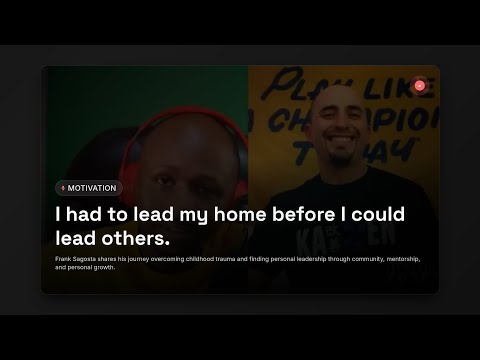
If it doesn't challenge you, it won't change you — the line Frank Sagosta says he wrote on his own mirror and now uses on kids who think no one can reach them.
Overcoming Childhood Trauma: Frank Sagosta’s Journey to Personal Leadership & Healing
Some guests come on a podcast to promote something. Frank Sagosta came on Hustle Zone to unpack a life. Introduced by host Ryan Perez as a husband, father, mentor, transformational speaker, entrepreneur, sports coach, and inventor — a man who also identifies as dyslexic, a product of a broken single-parent home, and a former ward of a boys’ orphanage — Sagosta spent the hour doing something he says he no longer flinches from: telling the truth about where he came from.
That truth starts early and hard. Sagosta describes growing up without a father and with a mother who was often unable to be present because of what he refers to as her illness — later specified as dementia, Alzheimer’s, and severe depression. In that vacuum, a man who lived across the street sexually abused him for years. As a child, he says, he mistook the attention for love, not understanding at the time whether what was happening was right or wrong. By his teenage years the confusion had curdled into something else entirely: hatred, anger, “straight up malice” — a rage at his abuser so consuming that he says he wanted the man dead, and that it pushed him toward drugs and drinking.
It wasn’t until he was 21 or 22 — around the time he married his wife (he was 19, she was 16; the two have now been married 17 years) — that he began to understand the abuse was never his fault. The turning point, he says, came when he finally told his wife what had happened to him. Both of them wept. He describes the moment as feeling “like somebody had lifted a big old bag off my shoulders” — the first real release of what he calls the demons, hatred, and corruption he’d been carrying silently.
The rest of his story is a chain of hard turns. Around age 9 or 10 he was taken from his mother and placed with his sister; after a 1992 California earthquake, a car incident got pinned on him, and his sister told authorities to “take him.” What followed was a stretch of running from foster home to foster home, and, at 11, a night spent homeless in an abandoned house in Barstow, California, crying himself to sleep and missing his mother — a memory he says still hits hardest of all. In 1994, San Bernardino County Sheriff’s deputies picked him up and gave him a choice: military camp or a boys’ orphanage. He chose the orphanage, where he spent the first days barely speaking or eating. A turnaround came through a counselor — a Notre Dame graduate and former Los Angeles Rams player — who mentored him into sports and repeated one phrase to him for years: “Frankie, be a champion.” Sagosta says he was the only boy who ever passed through that home to graduate high school, and he completed the orphanage’s program with full honors after five years and roughly 125 rules to live by.
Adulthood brought its own reckonings. Sagosta says he was born out of wedlock and didn’t meet his biological father until 2015. He’s candid that his own marriage weathered infidelity and a separation he caused, and that he had to learn patience to keep it together. He talks about forgiving his abuser, forgiving his sister, and forgiving his mother — reasoning that she was only 26, a young single mother doing what she could — and about a harder task still: forgiving himself for the choices he made in the environments he says he chose to be part of.
Today, by his account, that history feeds directly into his work: a business called Coaching Beyond, a patent-pending invention, a 65-page self-help book drawn from his own story, and a personal habit of reading dozens of books a year despite dyslexia and not finishing college. He wears a shirt with the word for the Japanese philosophy of continuous, incremental improvement, describes waking before 3 a.m., and keeps a mirror inscribed with “winners win, losers lose” and “if it doesn’t challenge you, it won’t change you” — the tool, he says, he uses on youth who don’t believe anyone can reach them.
By the end of the conversation, Ryan Perez frames it plainly: this is what Hustle Zone is built on — people who tell the story, not just the glory.
Lessons from this one
Disclosing trauma to someone you trust can release shame that silence only compounds.
Sagosta says he carried hatred and "corruption" from his abuse for years until, around 21-22, he broke down and told his wife what had happened — describing the aftermath as feeling like a bag had been lifted off his shoulders.
One consistent, invested adult can redirect a child's trajectory even inside an institutional setting.
Sagosta credits a counselor at the boys' orphanage — a Notre Dame graduate and former NFL player who donated his time — with pulling him into sports and repeatedly telling him "Frankie, be a champion," a relationship he says he maintains to this day.
Reframing yourself as the author of your circumstances, not just a product of them, can restore a sense of agency after trauma.
Sagosta rejects the idea of being purely "a product of your environment," arguing that he chose the environments he ended up in, including the abandoned building he slept in as a homeless 11-year-old, and that owning that choice was part of his recovery.
Forgiving yourself can be a necessary precondition for forgiving others.
Sagosta describes having to forgive himself for the choices he made before he could fully forgive his mother and his sister, framing self-forgiveness as tied directly to self-esteem and to moving forward in stages.
Rigid personal habits and routines can function as a counterweight to a chaotic upbringing.
Sagosta describes waking before 3 a.m., reading dozens of books a year despite dyslexia and not completing college, and living by the Kaizen philosophy of continuous improvement printed on his shirt.
Sources
- Ullman, S. E. (2007). Relationship to Perpetrator, Disclosure, Social Reactions, and PTSD Symptoms in Child Sexual Abuse Survivors. Journal of Child Sexual Abuse, 16(1), 19-36.
- DuBois, D. L., Portillo, N., Rhodes, J. E., Silverthorn, N., & Valentine, J. C. (2011). How Effective Are Mentoring Programs for Youth? A Systematic Assessment of the Evidence. Psychological Science in the Public Interest, 12(2), 57-91.
- Cummings, J., & Swickert, R. (2010). Relationship between Locus of Control and Posttraumatic Growth. Individual Differences Research, 8(3).
- Cornish, M. A., & Wade, N. G. (2015). Working through past wrongdoing: Examination of a self-forgiveness counseling intervention. Journal of Counseling Psychology, 62(3), 521-528.
- Masten, A. S. (2001). Ordinary magic: Resilience processes in development. American Psychologist, 56(3), 227-238.
- Runtime
- 10m
- Show
- HustleZone
- Host
- Ryan Perez
Been through something like this?
HustleZone is conversations with people who built something out of the thing that was supposed to stop them. If that is you, say so.