
Stop Settling: Raise Your Relationship Standards for Real Fulfillment
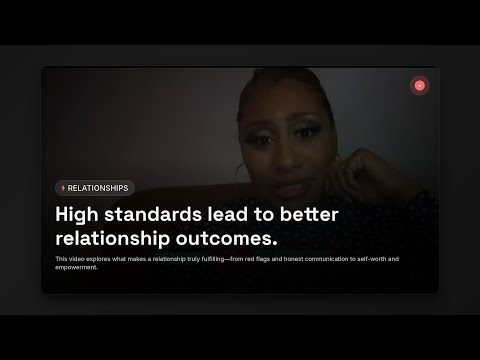
"Stop giving up your options for barely an option-in" — being low-maintenance isn't a virtue if it just means accepting low requirements from someone who isn't showing up.
Stop Settling: Raise Your Relationship Standards for Real Fulfillment
Episode seven of Peasant Sex and Relationships opens with host Twilight Ray marking the milestone with genuine enthusiasm — “I can’t even believe that it is episode seven already,” she tells viewers, before diving into the night’s centerpiece concept: the “satisfactory piece.”
It’s a term she says she coined herself, and she defines it bluntly: a satisfactory piece is a woman who prides herself on being low-maintenance, satisfied by the bare minimum, and who hands out “cookies, rewards, and accolades” for behavior that barely clears the floor. To help viewers spot themselves in the pattern, she lays out five identifying traits.
Low maintenance, she argues, isn’t the compliment women think it is. “Low maintenance means that you are low requirement,” she says — it just means a partner is getting away with doing the bare minimum because nothing more is being expected of him. Less drama works the same way: it often means a woman is overlooking red flags, ignoring bad behavior, and quietly lowering her standards to keep the peace. No title describes relationships where a woman is doing all the emotional labor of a girlfriend while her partner treats her as something casual — prompting one of Twila’s signature lines: “stop giving up your options for barely an option-in.”
The fourth trait, the bare minimum, gets broken into three sub-signals: “fake consistency” good-morning texts sent just to check a box, the instinct that “if it feels basic, it is basic,” and men who are simply going through the motions to keep a woman hooked without real investment. The fifth is being on retainer — a bit Twila compares to a lawyer on retainer, and she runs through five diagnostic questions, including whether a partner only reaches out when he “has a need,” whether the relationship feels inconsistent, and whether a woman feels like she’s constantly adjusting or justifying his behavior.
Twila gets personal here, admitting she used to be a satisfactory piece herself, proud of being low-maintenance and drama-free, and admits she used to look down on “high-maintenance” women — who, she now points out, “get what they want… every single time.”
Producer and co-host Ryan Perez joins partway through, offering a counterpoint from the male side: some guys genuinely don’t know what value looks like, he says, and dating apps like Bumble put pressure on women to initiate that can flatten effort on both sides. The two go back and forth on texting versus voice notes (Ryan says he sends voice messages to bring tone and personality into a conversation that text can flatten), how a single letter like “K” can carry an entire history of pettiness, and how quickly a relationship’s real temperature shows up in the first few interactions — “if you’re still trying to figure out day three, day four, day five… that relationship is not for you,” Ryan says.
The conversation’s turning point is what Twila calls “the elephant in the room”: rejection. She argues that a lot of the over-giving, chasing, and standard-lowering isn’t really about the man at all — it’s about unresolved fear of rejection and abandonment that shows up in both romantic and platonic relationships. Women caught in that pattern, she says, keep adjusting themselves to receive love and attention “even if that love isn’t real.”
Her prescription is direct: require more, don’t settle, don’t overlook red flags, and — most importantly — “deal with your stuff.” Face the fear of rejection instead of trying to out-give it. She and Ryan also touch on confidence as what actually attracts attention (“men find confidence sexy,” she says, more than body or face), and Twila shares a tactic she uses with clients: renaming a partner’s contact in your phone from something affectionate to something that reflects his actual behavior, so the romanticized memory of “four boxes checked” doesn’t outweigh the eight boxes he never checked.
The episode closes on a practical note — Twila doesn’t prescribe a fixed healing timeline, saying only that “when a woman is done, she’s done” — before she plugs a next-day masterclass, “Sex Money Magic,” and her one-on-one coaching program.
Lessons from this one
Calling yourself 'low maintenance' can be a way of lowering your own requirements rather than a genuine virtue.
Twila explains that low maintenance 'means that you are low requirement' — it lets a partner get away with minimal effort because nothing more is being expected or asked of him. She admits she once wore the label as a 'badge of honor' without realizing what it actually enabled.
Fear of rejection and abandonment, more than the partner himself, often drives over-giving and chasing behavior.
Twila frames rejection as 'the elephant in the room,' arguing that women adjust their standards repeatedly because they're seeking acceptance and fear being alone — a pattern she says also shows up in platonic relationships, not just romantic ones.
Frequent low-effort contact (like a daily good-morning text) can be mistaken for real relational consistency.
Twila repeatedly flags 'fake consistency' — texts sent just to check a box — as different from genuine investment, and notes that women crave consistency because it builds felt security, making it easy to over-credit repetitive, low-effort gestures.
Selectively remembering a partner's few good moments can obscure a much larger pattern of unmet expectations.
Twila describes clients romanticizing the '4 boxes he checked' while ignoring the 8 he didn't, and recommends renaming a partner's phone contact to reflect his actual behavior as a way to break that romanticized memory.
Confidence, not appearance, is described as the primary driver of attraction in the conversation.
Twila tells women that 'men find confidence sexy' regardless of body type or looks, and Ryan agrees, adding that a partner with no sense of self or outside life gives him 'nothing to reach for.'
- Runtime
- 1h 20m
- Show
- Peasant Sex and Relationships
- Host
- Ryan Perez
Been through something like this?
Peasant Sex and Relationships is conversations with people who built something out of the thing that was supposed to stop them. If that is you, say so.