
How Tony Loyd Overcame Crisis to Find Purpose & Lead with Impact
Miracles find you while you're in motion — you can't 100% depend on luck, so you have to do the work every single day.
How Tony Loyd Overcame Crisis to Find Purpose & Lead with Impact
On this episode of Go Live and Prosper, host Ryan Perez sat down with Tony Loyd — bestselling author, keynote speaker, and coach who helps purpose-driven business leaders thrive so they can connect with others and contribute at deeper levels. Tony’s resume reads like a whirlwind tour of corporate America: he was recruited out of a technical consulting career in commercial nuclear power to John Deere, then moved to Diversey (a cleaning and sanitation spin-off of S.C. Johnson later sold to Sealed Air), then to medical device maker Medtronic, and finished his corporate run at Buffalo Wild Wings. He’s also been personally trained in climate science by former Vice President Al Gore, chairs work with the Climate Reality Project, and hosts the podcast Social Entrepreneur, which has been downloaded more than half a million times in over 180 countries. His book, Crazy Good Advice: 10 Lessons Learned From 150 Leading Social Entrepreneurs, grew directly out of that show.
Asked to go back to the beginning, Tony traced his story to Arkansas, where he grew up in what he calls “fairly poor circumstances” but a good family. His father had a relentless work ethic, having been raised in extreme poverty himself and determined to pull the family up to at least lower-middle-class stability. His mother, meanwhile, taught him something different — sitting with him in front of the television during the Civil Rights era, watching the Birmingham riots, and explaining what was happening and why it mattered. Above all, he says, she taught him to be a kind human being. Along the way, mentors kept appearing. Tony says he never actually applied for most of the jobs he held — people simply liked him, saw a fit, and helped him along. He calls facilitating the growth of others his real “superpower,” the thread that connects a technical career, a corporate career, and now coaching and speaking.
That other-orientation shows up again in a story Tony shares about an old mentor of Ryan’s named Larry, who pointed out that McDonald’s puts the number of people it’s served on its signs — never the money made. “You never see McDonald’s counting the money,” Tony recalls, “they count their people.” It’s a philosophy that also shapes his framework for a fulfilling life, which he breaks into three buckets: Thrive (physical, emotional, intellectual, and spiritual health), Connect (social, marital, and parental relationships), and Contribute (vocation, finances, and giving back time, talent, and money). Neglect any one piece, he warns, and something eventually breaks.
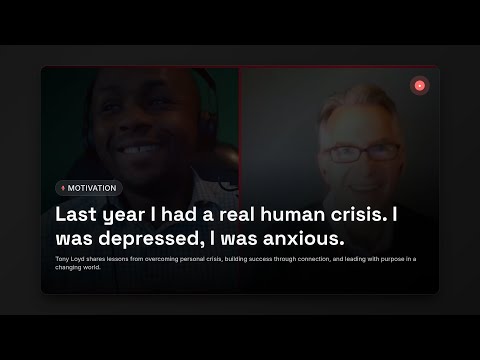
That’s exactly what happened to him. Tony describes going through “a real human crisis” the year before this conversation — depressed, anxious, overworked, and socially isolated by the demands of entrepreneurial life. His response was to run a self-assessment across Thrive, Connect, and Contribute, then build what he calls his “year of personal best.” He returned to serious running, switched to a plant-based diet, and the results were striking: 16.4 pounds lost, LDL down 29%, triglycerides down 38%, cholesterol down 40%, and 1,790 miles run — roughly the distance from Minneapolis to Miami — with personal bests set across 133 different race distances.
On success and luck, Tony pushes back on the “overnight success” myth, invoking Gary Vaynerchuk’s early YouTube wine videos, which he says went largely unnoticed for around 100 episodes. His mantra: “Miracles find you while you’re in motion.” Talent, activity, and luck are three buckets you can’t leave empty, but consistent daily action is the one you actually control.
The conversation also turned to money, education, and climate change. On finances, Tony — with repeated disclaimers that he’s not a financial advisor — recommended capturing a full 401k match, favoring whole-market index funds over individual stocks, and avoiding attempts to time the market. On education, he shared that he was 38 before finishing a traditional degree, eventually consolidating scattered college credits through Western Governors University. On climate, he argued that shared values, not political labels, unlock conversation across the divide, pointing to the bipartisan passage of the Clean Air and Clean Water Acts under the Nixon administration as proof government action can work. He closed by noting the tension in trade-offs like copper mining near Minnesota’s Boundary Waters for EV batteries, insisting “there are no jobs on a dead planet.”
The episode wrapped, fittingly, with a lightning round — including the story of how Tony met his wife through a pre-internet newspaper personal ad, and his offer to send Crazy Good Advice free to any listener who emails him mentioning Bow Tie Kreative.
Lessons from this one
Success is rarely a solo climb — mentorship and an other-orientation compound opportunity.
Tony says he never actually applied for most of the jobs he held; people liked him, were kind to him, and helped him to the next step. He frames his real skill as facilitating other people's growth rather than promoting himself, echoing a mentor's line that McDonald's counts the people it serves, not the money it makes.
Overnight success is largely a myth — small, consistent daily actions compound into breakthroughs.
Tony points to Gary Vaynerchuk's early YouTube videos for his family's wine business, noting Vaynerchuk was reportedly around 100 episodes in before anyone noticed. Tony's takeaway: 'tiny habitual actions in the right direction every day' matter more than banking on a lucky viral moment.
Sustainable wellbeing requires balancing self-care, relationships, and contribution — neglecting any one eventually breaks something.
After a year of depression, anxiety, and social isolation from overwork, Tony built a self-assessment and improvement plan across what he calls Thrive (physical/emotional/intellectual/spiritual health), Connect (social, marital, parental relationships), and Contribute (vocation, finances, giving back) — and says the results included measurable improvements in his weight, cholesterol, and running performance.
Simple, disciplined financial habits beat chasing high-risk bets.
Tony's investing advice was to capture at least the full employer 401k match, favor whole-market index funds (he references Vanguard) over individual stocks, avoid timing the market, and only consider higher-risk instruments like angel investing or venture capital once a solid retirement base exists.
Bridging political divides on climate requires anchoring conversations in shared values, not partisan labels.
Tony says he gets as much engagement on climate reality presentations in conservative rural areas as in liberal urban ones by focusing on shared values like family, health, and the outdoors rather than politics, and cites the bipartisan passage of the Clean Air and Clean Water Acts under the Nixon administration as evidence government action grounded in shared concern can work.
Sources
- Granovetter, M. S. (1973). "The Strength of Weak Ties." American Journal of Sociology, 78(6), 1360-1380.
- Eby, L. T., Allen, T. D., Evans, S. C., Ng, T., & DuBois, D. L. (2008). "Does mentoring matter? A multidisciplinary meta-analysis comparing mentored and non-mentored individuals." Journal of Vocational Behavior, 72(2), 254-267.
- Ericsson, K. A., Krampe, R. T., & Tesch-Romer, C. (1993). "The Role of Deliberate Practice in the Acquisition of Expert Performance." Psychological Review, 100(3), 363-406.
- Lally, P., van Jaarsveld, C. H. M., Potts, H. W. W., & Wardle, J. (2009). "How are habits formed: Modelling habit formation in the real world." European Journal of Social Psychology, 40(6), 998-1009.
- Deci, E. L., & Ryan, R. M. (2000). "The 'What' and 'Why' of Goal Pursuits: Human Needs and the Self-Determination of Behavior." Psychological Inquiry, 11(4), 227-268.
- Fama, E. F., & French, K. R. (2010). "Luck versus Skill in the Cross-Section of Mutual Fund Returns." The Journal of Finance, 65(5), 1915-1947.
- Feinberg, M., & Willer, R. (2013). "The Moral Roots of Environmental Attitudes." Psychological Science, 24(1), 56-62.
- Runtime
- 1h 03m
- Show
- HustleZone
- Host
- Ryan Perez
Been through something like this?
HustleZone is conversations with people who built something out of the thing that was supposed to stop them. If that is you, say so.