Not Lazy, Not Hopeless
Thriving with ADHD & Autism | Neurodivergent Growth Stories
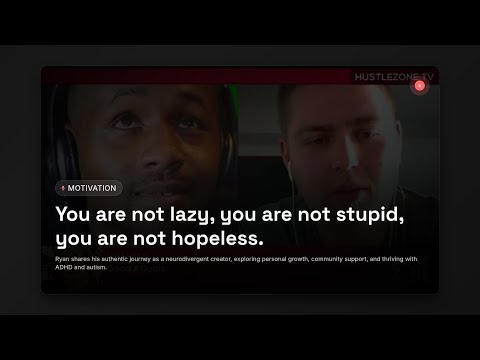
Dave Matthew doesn't call ADHD and brain injury a disability — he calls them the source of the ability and power that let him rebuild his whole life around helping kids.
Not Lazy, Not Hopeless: Dave Matthew on Brain Injury, ADHD, and Building a Youth Movement
This episode of Hustle Zone, hosted by Ryan Perez, brings back Dave Matthew — known through his youth-focused community formerly called Bodyguards United, now rebranded Be Heroes (Blue Heroes) — for a second, more polished round on the show. Ryan and Dave have known each other since elementary school and reconnected a few years ago while both were doing youth-facing work, Ryan through anti-bullying outreach and Dave through his security and mentorship career.
Dave’s story starts with an injury most people never plan for. Over more than seven years working security and bodyguard jobs, he sustained three serious concussions out of fifteen total, leaving him with a diagnosis of permanent brain damage that affected his vision and comprehension and intensified his existing ADHD symptoms. The injuries forced him to retire from active security work — the very job that had connected him to kids dealing with prostitution, gangs, drugs, and depression. Losing that access, he said, felt like losing a huge part of himself.
Rather than stop there, Dave began sharing his own history publicly: sixteen years of bullying and depression, and three suicide attempts. He found that opening up about his own experience built a following of young people willing to share theirs, and from that he built Be Heroes — a community explicitly designed around a discovery from his research: youth respond more to fellow youth than to adults, who they often feel are “preaching” at them. The community has since grown to 66 bureaus and 27 bureau ambassadors.
One story anchors why the work matters to him. He wrote about it on Medium in a piece called “A Simple Gesture”: a teenage girl was caught stealing from a Dollarama, and when Dave sat with her to explain the ban, he asked what was wrong instead of just processing the incident. She told him she was pregnant, her parents were on their way, and she had nowhere to go — the theft had been a fight-or-flight response to panic. He gave her twenty dollars and told her it wasn’t much but it was what he could do. More than a year later, she found him again to say the gesture had changed her trajectory: she’d graduated high school, had a healthy baby, and her family had taken her back in.
The conversation also covered Dave’s move into filmmaking. With LA director Dustin Callan, he co-created the short film Photographic Memory, featuring Dominique Swain and Disney Channel’s Mia Talarico, which premiered at the Wynn International Film Festival on October 20th and won Best Short Film on October 22nd. He and Callan are now developing a second short film centered on paranoia and PTSD. Dave also produced the Sunday Money Show for two years, the first season pre-recorded and edited, the second done live.
On the personal side, Dave spoke about his partner Claudia, whom he’s known since 1998 and has been with for years, and their two kids, Jacob and Julie. He was candid that building Be Heroes while broke — including a stretch of about two years of financial strain — put real pressure on the relationship, and that he considered leaving the work for a typical 9-to-5 more than once, only to find himself miserable each time he tried. Claudia, he said, came to see that the version of him chasing his passion was simply a better version of him.
The episode’s most direct thread is ADHD itself. Diagnosed in 1997, in grade seven, Dave was never medicated. For the six years before diagnosis, he says he was labeled lazy, unmotivated, easily distracted, and a class clown, and was even held back a grade — despite, by his account, getting the right answer on a math problem but being disciplined for solving it his own way. He now describes ADHD not as a disability but, in his words, something that gives him “ability and power” to get his ideas done, framing it alongside a friend’s push (referencing Michael D Haynes, who lives with cerebral palsy) to talk about “challenges” rather than “disabilities.”
Asked what he’d tell his younger self, Dave didn’t reach for a business lesson — he said he’d tell himself to be kinder to himself, pointing to his mother leaving when he was four and the six years he went undiagnosed as wounds that hurt more from the inside than anything anyone else did to him.
The episode closes, as Hustle Zone episodes do, with a lightning round — cheesecake over other desserts, talking over texting, Sunday as a favorite day, Vancouver Island as a favorite Canadian getaway, and a nod to Dave’s friend Casey Adams, a 17-year-old entrepreneur Dave describes as now a multimillionaire.
Lessons from this one
Reframing a diagnosis as a source of ability rather than a deficit can change how someone builds their entire life's work.
Real qualitative research on successful adults with ADHD backs the strength-based reframe Dave describes: participants in this study reported that traits often labeled 'deficits' (hyperfocus, high energy, creativity, resilience) were experienced as assets central to their achievements once reframed away from a pure-deficit disability model.
Peer-to-peer influence works better on young people than adult-delivered messaging.
A meta-analysis of cross-age peer mentoring programs for youth found a medium-sized overall positive effect on outcomes, consistent with the premise underlying Be Heroes' ambassador model that messages carried by fellow young people land differently than the same messages delivered by adults.
A single, small act of noticing someone in crisis can alter the course of their life.
No controlled study tests this specific anecdote's claimed outcomes (graduation, a healthy child, family reconciliation traced to one $20 gesture), so that exact causal chain reflects the guest's own retold story rather than research-backed fact. As related context: a leading meta-analysis of single-session interventions for youth found that even one brief, well-targeted contact can produce measurable improvements in adolescents' psychological outcomes, which lends some plausibility to the general mechanism (brief contact -> meaningful change) without validating this particular story's details.
Doubling down on strengths rather than fixing weaknesses is a more effective personal growth strategy.
A literature review of strengths-based interventions in positive psychology found consistent associations between strengths use/development approaches and improved wellbeing and performance outcomes, aligning with Dave's claim that society over-indexes on fixing weaknesses instead of building out natural strengths.
Sustained entrepreneurship under financial strain requires an explicit partnership agreement with the people closest to you, not just personal drive.
Academy of Management research specifically examining spouses as 'teammates' found spousal support and alignment to be a meaningful factor in whether entrepreneurs persist through hardship rather than quit, echoing the resolution Dave describes only once Claudia became aligned with his pursuit of Be Heroes.
Sources
- Sedgwick, J.A., Merwood, A., & Asherson, P. (2018). "The positive aspects of Attention Deficit Hyperactivity Disorder: a qualitative investigation of successful adults with ADHD." ADHD Attention Deficit and Hyperactivity Disorders.
- Burton, S., Raposa, E.B., Poon, C.Y.S., Stams, G.J.J.M., & Rhodes, J. (2021). "Cross-age peer mentoring for youth: A meta-analysis." American Journal of Community Psychology, 70.
- Schleider, J.L., & Weisz, J.R. (2017). "Little Treatments, Promising Effects? Meta-Analysis of Single-Session Interventions for Youth Psychiatric Problems." Journal of the American Academy of Child & Adolescent Psychiatry, 56(2), 107-115.
- Ghielen, S.T.S., van Woerkom, M., & Meyers, M.C. (2017). "Promoting positive outcomes through strengths interventions: A literature review." The Journal of Positive Psychology.
- Forster, W.R., & Pollack, J.M. (2014). "Impact of Spousal Teammates on Entrepreneurial Persistence." Academy of Management Proceedings, 2014(1).
- Runtime
- 51m
- Show
- HustleZone
- Host
- Ryan Perez
Been through something like this?
HustleZone is conversations with people who built something out of the thing that was supposed to stop them. If that is you, say so.