
MLM Uncovered
The Real Secrets Behind Multi-Level Marketing Success & Setbacks
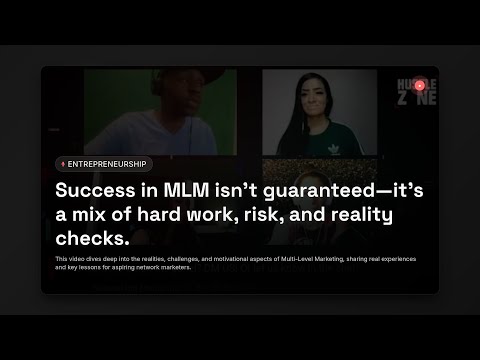
The real product in most MLMs isn't what's in the box — it's the motivational high of the conventions, and that high evaporates the moment you walk out the door.
MLM Uncovered: The Real Secrets Behind Multi-Level Marketing Success & Setbacks
This episode of Hustle Zone pulled together one of the show’s most opinionated panels yet to hash out a question that never quite gets settled: is multi-level marketing a legitimate business model, a cult-adjacent psychological machine, or a bit of both? Host Ryan brought in a rotating cast — Carrie of Underground Radio, business coach Q, motivational speaker and mental health coach Dave Matthew Body, “happiness guru” Roberta, and later Tanya, Anna, and DJ Tags — and let them argue it out in real time.
The conversation opened with a blunt question: is MLM designed so everyone can succeed? Carrie, still an active Beachbody coach after twelve to fifteen years, argued the success rate could climb above 80 percent — but only after two or three years of consistent work from everyone in the downline. Ryan pushed back hard, arguing the business model itself “thrives on people that are not qualified to be selling the products or qualified to network,” and that recruiters often target people from overseas or with little income whose only hope is climbing out of debt.
From there the panel tackled the cult question directly. Carrie described the unsettling feel of secret handshakes and hush-hush meetings in some groups. Q, who said she studies human behavior professionally, admitted the model “makes me crazy” from a psychological standpoint — comparing the conference-and-convention circuit to a drug, and to what she called “the Tony Robbins effect,” where emotion and hype substitute for facts and results. She noted people often lose that manufactured motivation the moment they leave the room. Dave, who said he’d run two MLM businesses, agreed the meetings can look cultish from the outside but insisted the psychology behind them genuinely works — his own upline became multi-millionaires. Roberta took the most favorable view, framing the structure as a vehicle for real personal development.
The money conversation got sharper once Monica asked whether people should pay real cash to get in. Roberta suggested even a losing investment can be “a lesson in itself” if you go in with discernment and don’t rush. Dave laid out concrete due-diligence advice: study the compensation plan, avoid companies less than five years old, check the Better Business Bureau, and — critically — remember that the legal line between a real MLM and an illegal pyramid scheme comes down to whether an actual product or service changes hands with a paying customer. He also cited the industry’s scale, describing over 60 registered MLM businesses worldwide collectively generating roughly $200 billion a year. Q added a darker observation: predatory recruiters specifically target people whose entry fee matches, to the penny, whatever is left in their bank account.
The most sobering story came from Tanya, who joined World Financial Group in 2007 and became a fast success by her own account — she sold $700,000 worth of investments within six months. But she’d joined right before the 2008 crash, and her upline had structured things so that her first $600,000 in commissions went to him rather than her. When the market collapsed, clients she’d personally recruited — friends and family — lost heavily. “The moment somebody says to me MLM, I’m out,” she said. Anna offered a smaller-scale version of the same regret, describing a kit she’d bought into with a friend, struggling to sell it, and eventually returning most of the product. She also brought up LuLaRoe’s public unraveling over supply and overcharging issues as a cautionary tale.
The panel closed on whether sales itself can be taught. Q argued that most MLM structures fail people because they force one rigid script instead of “meeting people where they’re at.” Roberta believes sales is a learnable storytelling skill. Tanya invoked Madam C.J. Walker as an early master of story-driven selling, but insisted talent still matters — not everyone who wants to sing gets to keep singing once the judges weigh in.
By the end, Monica summed up her own takeaway as landing squarely at 50/50: MLM isn’t inherently a scam, but success depends entirely on research, self-awareness, and never risking money you can’t afford to lose. Ryan closed the show with the same message the whole panel seemed to agree on — learn to sell, learn to follow a system, and never bet your life savings on the promise alone.
Lessons from this one
MLM's engine runs more on manufactured emotion than on facts, and that motivation fades once people leave the environment.
An academic chapter specifically examining this dynamic finds that MLM organizations deliberately deploy personal-development and motivational-seminar culture (conventions, rallies, 'testimony' sessions) to generate emotional highs that drive recruitment and retention, functioning more as psychological conditioning than as evidence-based business training -- directly consistent with Q's 'Tony Robbins effect' observation that the model runs on feeling rather than stats, and that people struggle once the emotional high fades.
The legal and practical line between a legitimate direct-selling business and an illegal pyramid scheme is whether a real product or service actually reaches a paying customer.
The FTC's own consumer guidance states this exact test in plain language: a legitimate MLM 'will pay you based on your sales to retail customers, without having to recruit new distributors,' whereas in an illegal pyramid scheme 'your income would be based mostly on how many people you recruit, not how much product you sell,' with distributors buying inventory just to qualify for bonuses rather than to meet real customer demand -- this is precisely the distinction Dave draws between a registered MLM and a pure recruitment scheme.
Recruitment in MLM disproportionately targets financially vulnerable people, and that dynamic shapes who ends up succeeding versus who ends up exploited.
An academic chapter on MLM recruitment and socialization tactics documents how recruiters build personal rapport and target people through existing social and financial pressure points to draw them in. This is reinforced by empirical evidence from a large FTC-settlement dataset (over 350,000 participants) showing that financial losses from MLM participation were concentrated in areas with greater income inequality and diminished social capital -- i.e., the people who lost the most were disproportionately those in more economically vulnerable circumstances, consistent with Ryan's and Q's claims about who gets targeted.
Real income outcomes in MLM are heavily skewed -- a few highly visible successes coexist with widespread losses, even for people who initially perform well.
A peer-reviewed study analyzing data from an actual FTC settlement with a major MLM (over 350,000 individuals) found that participation and losses were unevenly distributed: refund-claimant rates were higher in more affluent areas (consistent with MLM's appeal as flexible income), while the size of financial losses correlated with greater local inequality and lower social capital -- direct empirical evidence of the skewed, uneven outcome pattern Tanya describes (a period of high sales followed by a heavy loss when conditions turned).
Sales ability is a mix of teachable skill and individual disposition, and one-size-fits-all MLM 'systems' fail people who don't fit that mold.
A large meta-analytic review of predictors of salesperson job performance found that both aptitude/skill measures (which can be trained) and personality traits (relatively stable individual dispositions) each contribute meaningfully and independently to sales success, with no single trait or technique working equally well for everyone -- supporting the idea that Q's flexible 'meet people where they're at' approach and Tanya's point about Madam C.J. Walker's non-transferable personal gift both reflect a real mix of trainable skill and individual disposition, which a single rigid MLM script cannot fully capture.
Sources
- Lucas Dixon (2026), "Motivation or manipulation? How multilevel marketing uses personal development to attract and retain distributors," in Deanna Grant-Smith & Claudia Groß (eds.), Critical Perspectives on Multilevel Marketing, Edward Elgar Publishing, pp. 136-156.
- Federal Trade Commission, "Multi-Level Marketing Businesses and Pyramid Schemes," FTC Consumer Advice (consumer.ftc.gov).
- Claudia Groß & Douglas M. Brooks (2026), "Cultivating connections: how MLMs recruit and socialise their participants," in Critical Perspectives on Multilevel Marketing, Edward Elgar Publishing, pp. 100-119.
- Claes Bäckman & Tobin Hanspal (2022), "Participation and losses in multi-level marketing: Evidence from a Federal Trade Commission settlement," Financial Planning Review, 5(1), e1137, Wiley.
- Andrew J. Vinchur, Jeffery S. Schippmann, Fred S. Switzer III, & Philip L. Roth (1998), "A Meta-Analytic Review of Predictors of Job Performance for Salespeople," Journal of Applied Psychology, 83(4), 586-597.
- Runtime
- 1h 38m
- Show
- HustleZone
- Host
- Ryan Perez
Been through something like this?
HustleZone is conversations with people who built something out of the thing that was supposed to stop them. If that is you, say so.